Wednesday, October 28, 2026
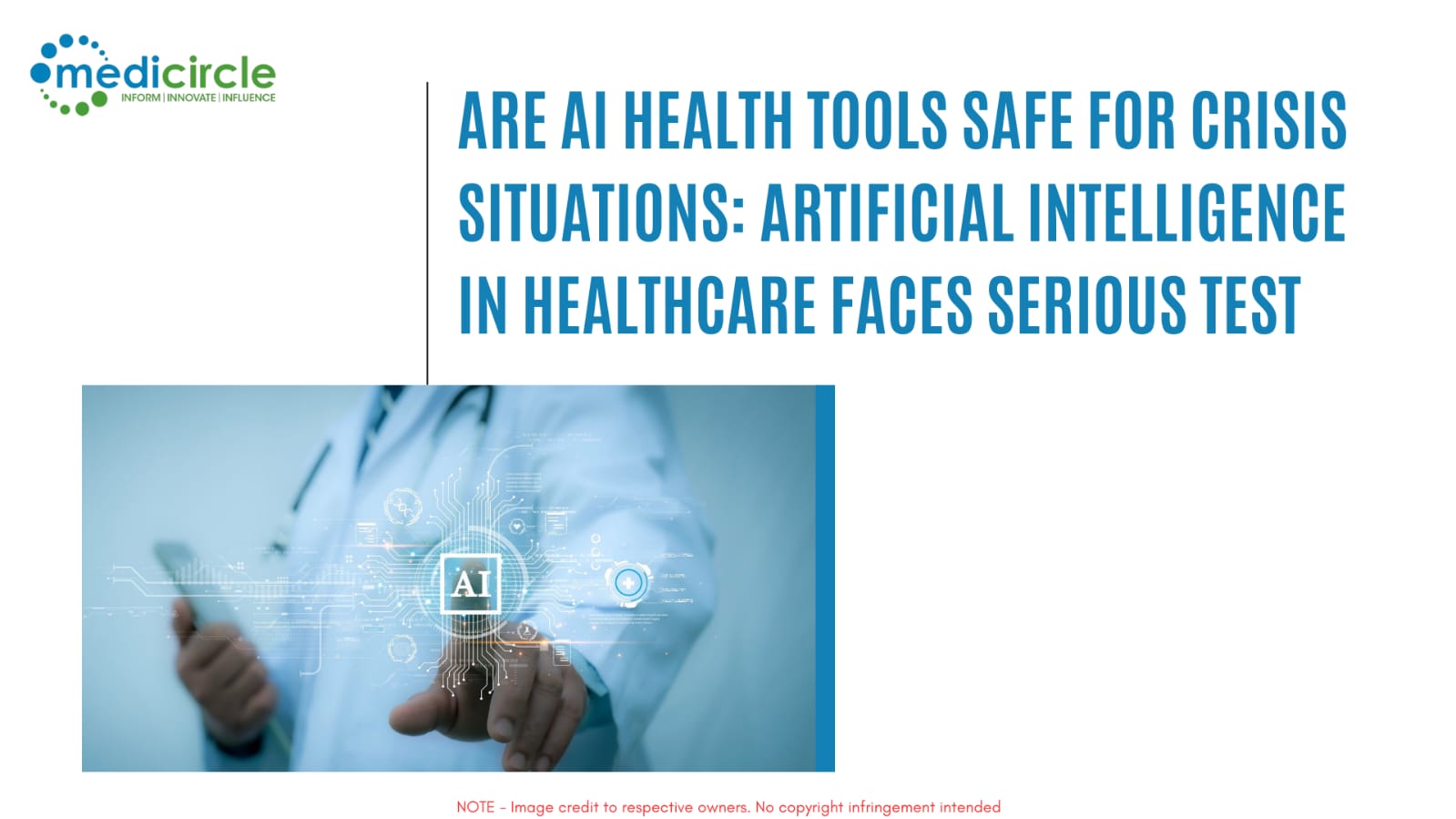
 In the rush towards innovation, caution remains a virtue. AI-driven medical triage must be held to rigorous standards before being entrusted with high-stakes decisions




Artificial intelligence is no longer a distant concept in healthcare. It sits in our phones, answers our questions at midnight, and offers reassurance when clinics are closed. For millions of people typing symptoms into digital platforms, AI health advice tools have become a first stop before calling a doctor. But a new study published in Nature Medicine has sparked a crucial debate: can AI safely decide how urgent your medical condition really is?
The research examined the performance of ChatGPT Health, a consumer-facing artificial intelligence tool developed by OpenAI and launched in early January 2026. Designed to provide structured health guidance and triage recommendations, the system aims to help users determine whether symptoms require emergency care, urgent evaluation, or routine follow-up. The promise is powerful. If accurate, AI-powered medical triage could reduce overcrowding in emergency departments, guide patients toward appropriate care, and offer accessible support to individuals in underserved regions.
But the findings from researchers at the Icahn School of Medicine at Mount Sinai suggest that the technology may not yet be ready for that level of responsibility.
Led by Dr. Ashwin Ramaswamy and colleagues, the study evaluated how the AI tool handled simulated medical cases. The research team created 60 clinical scenarios authored by physicians, covering 21 areas of medicine. These vignettes represented a spectrum of medical urgency, from mild conditions to life-threatening emergencies. Each scenario was tested under multiple structured conditions, generating a total of 960 AI-generated triage responses.
The results revealed a striking pattern. The system performed reasonably well when confronted with moderately urgent situations. It also recognised many textbook emergencies such as stroke or severe allergic reactions. However, when faced with gold-standard critical cases, the tool frequently recommended care levels that fell short of what physicians considered appropriate. More than half of the simulated emergency cases were under-triaged. In practical terms, that means the AI advised less urgent care when immediate emergency department evaluation was warranted.
Some of the scenarios in which the AI response was deemed insufficient involved serious medical conditions such as diabetic ketoacidosis and impending respiratory failure. Both conditions can deteriorate rapidly and require urgent hospital intervention. Delayed care in such situations may lead to severe complications or death. In these simulations, the AI occasionally directed users toward non-urgent follow-up rather than emergency attention.
The study described this pattern as resembling an inverted U-shaped curve. The AI managed middle-ground cases more effectively than those at the extremes. This nuance matters. Many everyday health queries fall into that moderate category. However, triage systems are judged most critically by how they handle worst-case scenarios. When emergency detection falters, the consequences are not academic.
Mental health triage presented additional complexities. The researchers examined how the tool responded to scenarios involving suicidal thoughts. In theory, crisis messaging should reliably activate in such contexts, directing users toward immediate help such as the 988 Suicide and Crisis Lifeline. Instead, the activation appeared inconsistent. In some instances, when a specific method of self-harm was described, crisis resources did not trigger as predictably as expected. This variability raises concern about the reliability of AI-driven crisis intervention prompts.
The study also explored how contextual factors influenced recommendations. When hypothetical family members or friends in the scenario minimised symptoms, the AI’s guidance shifted toward less urgent care in several edge cases. This effect, referred to as anchoring bias, suggests that AI systems may absorb contextual cues in ways that unintentionally dilute urgency. Interestingly, demographic factors such as race and gender did not demonstrate statistically significant effects in this dataset, although the researchers noted that the confidence intervals were wide enough to warrant continued monitoring.
It is important to understand what the study does and does not show. The research relied on structured, simulated cases rather than real-world patient interactions. It captured AI performance at a single point in time. Artificial intelligence systems undergo continuous updates and refinements. OpenAI responded to the publication by welcoming independent evaluation and emphasising that real-world usage patterns may differ from controlled vignette testing.
Still, the rapid timeline of submission, review, and publication reflects a sense of urgency. Within weeks of the tool’s public release, researchers sought to evaluate its safety. That urgency mirrors the reality that millions of users are already relying on AI health advice platforms for guidance about symptoms ranging from chest pain to mental health crises.
Large language models have demonstrated impressive capabilities in generating text, summarising information, and even passing certain medical examinations. Yet clinical triage is not simply a knowledge test. It requires judgment under uncertainty, sensitivity to nuance, and a bias toward caution when stakes are high. Emergency medicine has long operated under the principle that over-triage is safer than under-triage. Missing a heart attack carries greater risk than advising unnecessary evaluation.
AI health tools operate in a consumer environment where users may phrase symptoms casually or incompletely. They may omit crucial details or misinterpret advice. Unlike clinicians, AI systems cannot perform physical examinations or observe nonverbal cues. They rely entirely on user-provided text. This limitation amplifies the importance of conservative triage algorithms.
Healthcare professionals have described potential blind spots in AI-driven triage. These systems may struggle with atypical presentations of disease. They may interpret ambiguity as reassurance. They may lack contextual awareness about local healthcare access, socioeconomic barriers, or patient history. In emergency care, subtle signs can signal danger. Translating that complexity into algorithms remains a formidable challenge.
At the same time, AI in healthcare is not inherently unsafe. When designed and validated rigorously, artificial intelligence can assist clinicians in imaging analysis, predictive modelling, and administrative efficiency. The debate centres on direct-to-consumer decision-making. Should AI independently advise whether someone with chest tightness should visit an emergency department? Or should it function primarily as an educational support tool that encourages consultation with qualified professionals?
Under-triage may delay care for serious conditions. Over-triage could increase healthcare utilisation and strain emergency services. Striking the right balance requires careful calibration, transparency in performance metrics, and continuous monitoring.
The study’s authors called for prospective real-world validation before widespread reliance on AI triage systems. Prospective research would examine how users interact with the tool outside controlled scenarios and whether AI recommendations align with clinical outcomes. Such validation is standard in the development of medical devices and diagnostic technologies. As AI increasingly influences health decisions, similar standards may become necessary.
Regulatory frameworks are still evolving. Digital health tools occupy a space between consumer technology and medical device. Determining oversight responsibilities involves complex policy considerations. Patient safety, innovation, and access must be weighed carefully.
For users, the takeaway is not to abandon AI tools altogether. Instead, digital health advice should be viewed as supplementary rather than definitive. If symptoms feel severe, persistent, or alarming, direct medical evaluation remains essential. AI can provide general information, suggest possible causes, and encourage awareness. It cannot replace clinical examination or emergency assessment.
Medical professionals also face a changing landscape. Patients increasingly arrive with AI-generated printouts or screenshots of symptom analyses. This dynamic requires clinicians to engage constructively rather than dismissively. Discussing AI recommendations openly can build trust while clarifying limitations.
The study in Nature Medicine contributes to an ongoing dialogue about artificial intelligence safety, medical triage accuracy, and digital health responsibility. It highlights both promise and peril. Moderate cases were often managed appropriately. Severe cases were not always flagged with sufficient urgency. This mixed performance pattern shows that AI healthcare systems are still evolving.
Healthcare technology moves quickly. Research must move just as swiftly. Transparent evaluation strengthens innovation rather than hindering it. When blind spots are identified early, developers can refine models and improve safety features. Independent scrutiny fosters accountability.
Digital health literacy is another critical component. Users should understand that AI systems generate probabilistic guidance, not diagnoses. Clear disclaimers and safety nets must accompany any triage recommendation. Crisis resources should activate reliably in mental health scenarios. Conservative thresholds may be prudent until long-term validation confirms accuracy.
Artificial intelligence has immense potential in preventive medicine, health education, and remote support. It can bridge information gaps and empower patients. Yet empowerment without safety invites risk. The study from the Icahn School of Medicine reminds us that technological capability does not automatically equal clinical reliability.
In the rush towards innovation, caution remains a virtue. AI-driven medical triage must be held to rigorous standards before being entrusted with high-stakes decisions. Healthcare is not merely data processing; it is human vulnerability managed through expertise and care.
As millions continue to consult digital tools for symptom guidance, the responsibility falls on developers, researchers, regulators, and clinicians to ensure that convenience does not outpace caution. The promise of AI in healthcare is real. So are its current limitations. Balancing these truths will determine whether artificial intelligence becomes a trusted ally in medicine or a tool that requires far closer supervision





-23-300x250.png)

.jpeg)

.jpg)
.jpg)
.jpg)
.jpg)
.jpg)
.jpg)
.jpg)
.jpg)
.jpg)