 Thursday, October 08, 2026
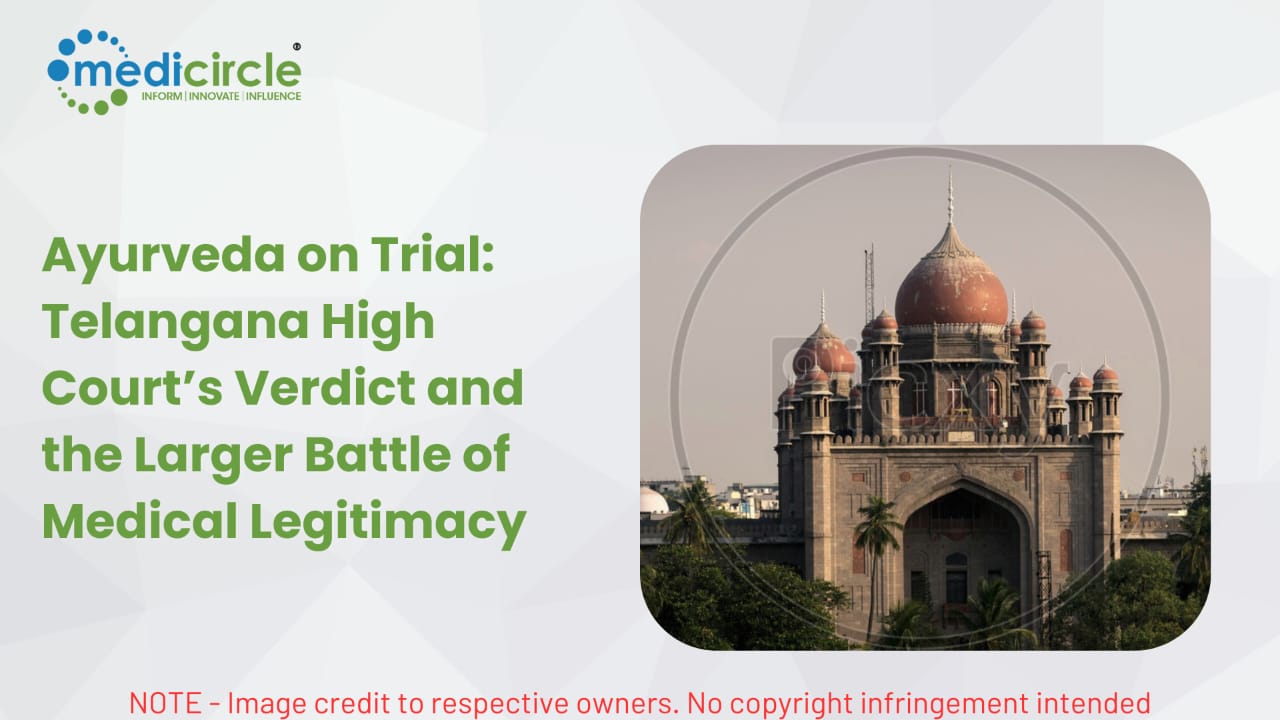
 A patient deserves to know whether the person prescribing treatment is an Ayurveda doctor, an MBBS doctor, or someone misrepresenting qualifications.




In the world of medicine, questions of legitimacy, boundaries, and the right to heal have always sparked controversy. On September 2, 2025, the Telangana High Court delivered a ruling that has stirred debate not only in legal circles but also in the medical fraternity across India. The judgment came in a case involving three Ayurveda doctors accused of practising modern allopathic medicine without appropriate registration. The court dismissed the criminal charges filed against them, stating that the Telangana State Medical Council had not adhered to the proper legal procedure when pressing the charges. Yet, while the dismissal brought temporary relief to the practitioners, it also left the door open for further proceedings if the authorities choose to follow due process in the future. This case, while rooted in a specific legal dispute, opens a larger conversation about the uneasy coexistence of different streams of medicine in India, the enforcement of boundaries between them, and the pressing need to respect both the law and patient safety.
The dismissal of the cases was ordered by Justice N. Tukaramji, who made it clear that the State Medical Council cannot bypass due process while exercising its powers. According to the judgment, the correct procedure requires the Council to first forward such matters to the Commissioner of AYUSH, the governing body for Indian systems of medicine, and then, if there is sufficient evidence, file a complaint with the police. Only after such procedural steps are properly observed can criminal charges be legitimately sustained. This emphasis on process is critical because in a democracy governed by law, shortcuts in regulation cannot stand the test of judicial scrutiny. The doctors in this case were booked in May 2025, after a surprise inspection by the Medical Council at their clinics in Cyberabad and Rangareddy, where evidence of alleged allopathic practice was collected. The charges sparked outrage, since many believed that Ayurveda practitioners were overstepping their qualifications, while others argued that such practitioners often provide essential services in areas where modern medical practitioners are scarce.
The High Court’s ruling, while quashing the criminal charges, is not a clean slate for the doctors. The judgment explicitly states that the Medical Council retains the authority to act, but it must first take the correct path through AYUSH and submit detailed, evidence-based complaints if it intends to pursue the matter further. This leaves the accused doctors in a state of uncertainty, relieved of immediate criminal prosecution but still under the shadow of potential disciplinary proceedings. It also leaves the wider medical fraternity questioning where the lines between different systems of healing truly lie and who gets to enforce them.
This case represents the ongoing struggle to reconcile India’s pluralistic healthcare landscape. Ayurveda, with its centuries-old roots, is often celebrated as part of India’s cultural identity. Yet the rise of modern medicine, backed by rigorous scientific validation, has created sharp divisions about who is entitled to practise what. While patients often move freely between Ayurvedic remedies and allopathic prescriptions, the law demands stricter boundaries. Practising modern medicine without registration under the Indian Medical Council Act, or its successors, constitutes quackery under the law, and courts have repeatedly upheld this principle in past cases. However, the Telangana High Court’s insistence on procedural propriety suggests that enforcement cannot be arbitrary, even when the suspicion of illegality is strong.
The controversy also highlights the precarious situation faced by many Ayurveda doctors. In rural and semi-urban parts of India, these practitioners often step in to fill gaps left by the shortage of MBBS doctors. Patients frequently approach them not only for herbal remedies but also for general medical complaints, creating a situation where boundaries blur in practice even if the law says otherwise. For many communities, the local Ayurveda doctor is the first line of care, and in emergencies, people expect them to act beyond their officially sanctioned scope. Yet when such practitioners respond to these expectations, they risk prosecution for overstepping their professional boundaries. This paradox lies at the heart of the Telangana case: the public demands access to medical services, but the law demands adherence to rigid definitions of practice.
From a regulatory perspective, the judgment highlights the responsibility of councils and commissions to uphold standards without compromising fairness. The Telangana State Medical Council erred by bypassing the AYUSH Commissioner and directly involving the police, leading to the collapse of its case. For regulatory authorities, this is a reminder that due diligence is not a formality but the bedrock of accountability. If medical councils fail to follow lawful procedures, they risk weakening the very enforcement mechanisms designed to protect patients from unqualified practitioners. For doctors, this case demonstrates how careers can be entangled in procedural lapses that undermine the clarity of professional boundaries.
The decision also raises deeper ethical questions. Should an Ayurveda doctor who administers an antibiotic or prescribes painkillers in the absence of an MBBS doctor be considered a criminal, or a pragmatic caregiver responding to patient needs? Should the law evolve to reflect the realities of India’s healthcare shortages, or should it stand firm to protect the integrity of medical practice? These questions have no easy answers, but they cannot be ignored in a country where lakhs of patients depend on traditional systems of medicine alongside modern ones. The High Court has not settled these issues; it has simply redirected the responsibility back to regulators to handle them with greater care and legality.
For the larger medical community, this ruling is both a caution and an opportunity. It is a caution because it shows how easily poorly executed regulatory actions can collapse under judicial scrutiny, weakening the credibility of enforcement efforts. It is also an opportunity because it brings into focus the urgent need for dialogue between modern and traditional systems of medicine. India has long promoted integrative healthcare, encouraging Ayurveda, Unani, Siddha, and Homeopathy to coexist with allopathy. Yet integration cannot mean dilution of standards. Doctors trained in Ayurveda must work within their scope, while patients deserve full transparency about the qualifications of the person treating them. When these conditions are met, integration can enhance healthcare delivery. When they are ignored, confusion, exploitation, and legal battles ensue.
The Telangana case may appear to revolve around three individual doctors, but in reality, it reflects systemic issues in healthcare governance. The shortage of MBBS doctors, particularly in rural areas, pushes patients toward Ayurveda and other traditional practitioners. The regulatory machinery, often stretched thin, struggles to enforce boundaries consistently. Patients, caught between the promise of care and the fear of malpractice, are left with little clarity. Courts, meanwhile, step in to arbitrate these disputes, but their role is limited to interpreting laws, not creating new healthcare frameworks. As a result, judgments like this one resolve specific cases without addressing the structural tensions that give rise to them.
In reflecting on this case, one cannot escape the conclusion that the future of healthcare in India requires both clarity and compassion. Clarity in defining the scope of each system, in ensuring that enforcement is fair and lawful, and in educating patients about the qualifications of their providers. Compassion in recognizing the realities of medical shortages, the cultural significance of Ayurveda, and the genuine intent of many practitioners to serve communities in need. Without such balance, the healthcare ecosystem risks swinging between rigid prohibition and unchecked quackery, neither of which serves patients well.
Ultimately, the Telangana High Court’s ruling is a chapter in a much larger story. It is the story of how India, a country of diverse healing traditions, negotiates the boundaries between ancient wisdom and modern science. It is the story of how regulatory institutions struggles with enforcement in an overburdened healthcare system. And it is the story of how doctors, regardless of their training, must navigate the fine line between care and legality. For the three Ayurveda doctors at the center of this case, the dismissal of criminal charges is a reprieve, but not an exoneration. For the medical councils, it is a warning to act with both authority and caution. For patients, it is a reminder that the legitimacy of care lies not just in trust, but in the qualifications and accountability of those who provide it.
In the end, the verdict has reaffirmed a timeless truth that in medicine, trust is paramount, but trust must be built on transparency and legitimacy. A patient deserves to know whether the person prescribing treatment is an Ayurveda doctor, an MBBS doctor, or someone misrepresenting qualifications. Regulators must ensure that this clarity exists, not through shortcuts, but through robust, lawful processes. Courts, as guardians of fairness, will continue to intervene when procedures are ignored. And society, as the ultimate stakeholder in healthcare, must continue to demand both access and integrity. The Telangana High Court may have closed the chapter on one set of criminal cases, but the larger book of medical legitimacy in India remains unfinished, waiting for more decisive answers that protect patients while respecting the diversity of healing traditions





.jpeg)










.jpg)
.jpg)
.jpg)
.jpg)
.jpg)
.jpg)


.jpg)