 Thursday, October 08, 2026
 Bihar cannot afford to wait for the problem to escalate. Uranium contamination is not just a scientific finding; it is a social warning.




There are stories that shake you long after you stop reading them. Stories that resurface in your mind during the most ordinary moments when holding a child, when watching a mother feed her baby, when thinking about the trust we place in the natural world. The recent scientific study from Bihar forces India to ask a question no one ever imagined would be relevant: what happens when breastmilk, the purest food known to humankind, carries traces of uranium?
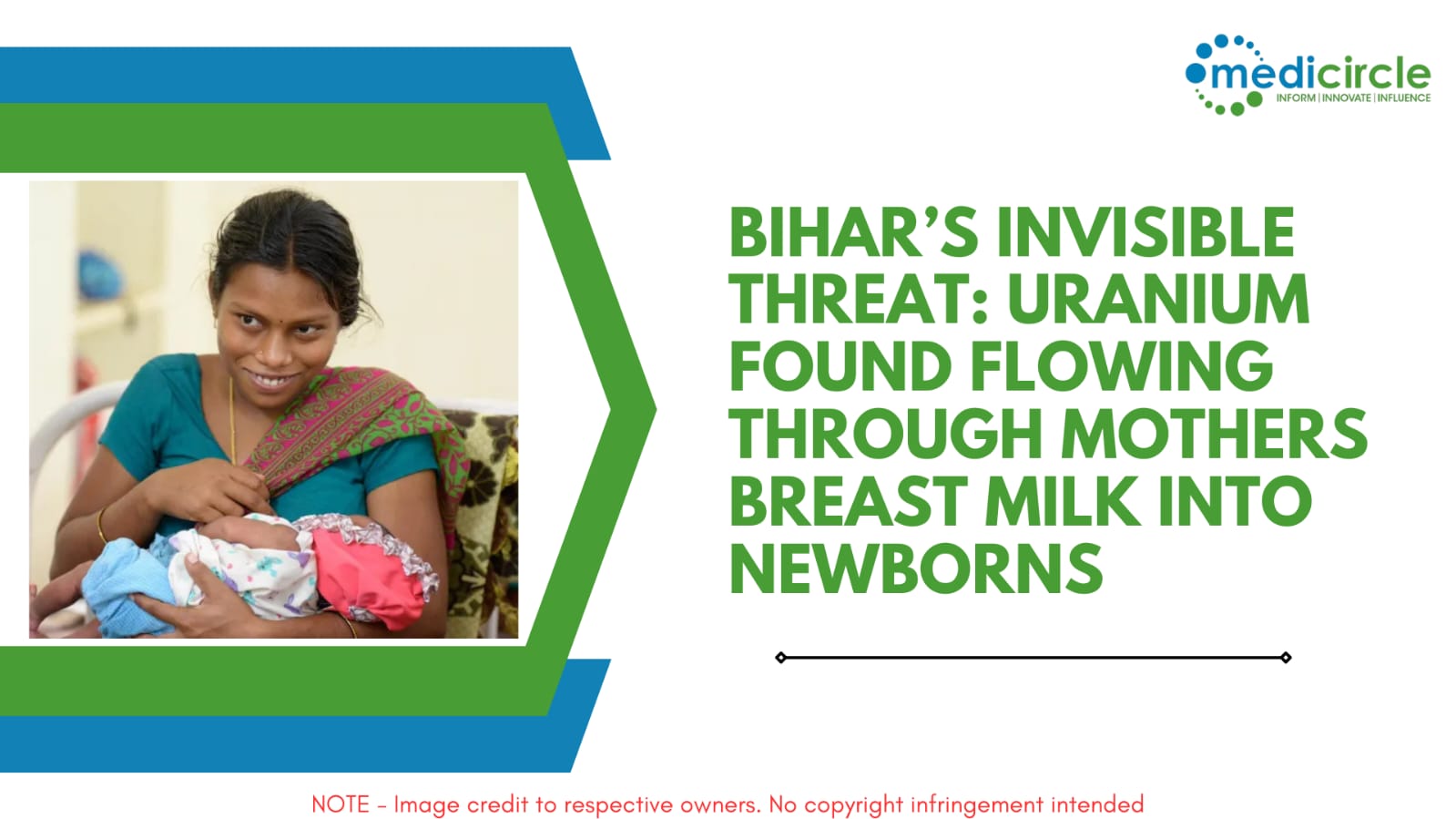
Breastmilk has always been treated as the safest beginning for a newborn’s life. It is the first shield, the first medicine, the first immunity lesson. But a new investigation, carried out by researchers from Mahavir Cancer Sansthan & Research Centre in Patna along with academic teams from Lovely Professional University and NIPER-Hajipur, has uncovered an uncomfortable truth. Every lactating mother tested across six districts of Bihar was found to have uranium in her breastmilk. The discovery, presented in Scientific Reports, is the first documented evidence from the Gangetic plains, and the findings are difficult to brush aside.
The researchers had collected breastmilk samples from mothers aged 17 to 35, living in Bhojpur, Samastipur, Begusarai, Khagaria, Katihar, and Nalanda. These were not women from industrial belts or mining zones. These were everyday households, shaped by groundwater use, rural routines, and traditional lifestyles, families that would never expect to be entangled in radioactive contamination. Yet the study revealed that uranium traces were present in every single sample picked for analysis. The intensity varied from woman to woman, but the presence was universal.
One district after another revealed uncomfortable numbers. Khagaria showed the highest average contamination, while Katihar registered the single highest uranium peak, touching levels that should have never made their way into a mother’s body in the first place. Nalanda recorded the lowest mean, yet even that “low” figure carried no comfort because the baseline itself was wrong. Breastmilk should not hold uranium at all. Its presence even in micrograms, signals that something deeper is wrong in Bihar’s water and soil.
The team visualised these findings through spatial maps, revealing a wider environmental footprint across the state. The patterns looked less like isolated blips and more like a slow-moving wave that has likely been building over years, fed by groundwater exposure that millions depend on. Bihar has been struggling with arsenic, lead, mercury and several other heavy metals for decades. Uranium now joins that list, complicating an already tangled public health crisis.
Infants, who rely completely on breastmilk for the first months of their lives, remain the most vulnerable of all. To understand how much risk this contamination poses, the researchers used a Monte Carlo simulation i.e. a powerful statistical method that runs thousands of possibilities to predict real-life outcomes. The results were disturbing. Nearly 70% of infants were found to be at risk of developing non-cancer health problems due to uranium exposure through breastmilk. Their tiny bodies are ill-equipped to flush out heavy metals. Their organs are still learning how to function. Their kidneys are still developing the filtration capacity that adults take for granted. Even small amounts of uranium can cause disproportionately large effects.
The study pointed out that while the cancer risk from these levels appears low for now, the chemical toxicity of uranium is far more pressing than its radioactive nature. Uranium is known to cause kidney damage, affect brain development, interfere with motor skills, disturb the immune system, and contribute to cognitive problems later in life. What makes this metal even more alarming is its ability to cross the blood–brain barrier and, during pregnancy, the placenta. A toxic metal that can enter the one organ that controls memory, learning, and behaviour raises questions that no society can afford to ignore.
Interestingly, the study also observed that uranium does not build up heavily in breast tissue. The breastmilk contamination likely reflects short-term exposure (what mothers consumed recently) rather than how much uranium their bodies have stored over years. This aligns with global scientific evidence showing that uranium tends to settle in bones and kidneys rather than in milk. Even so, “less accumulation” does not equal “less danger.” The fact that breastmilk still contains uranium means the contamination cycle is ongoing and persistent in the environment.
For a moment, one might wonder if the answer lies in telling mothers to stop breastfeeding. But the scientists behind the study firmly caution against such a drastic response. Breastfeeding remains the best form of infant nutrition. Its benefits are well-documented, from immunity to bonding to long-term health advantages. The uranium levels, though concerning, do not justify abruptly ending breastfeeding without medical supervision. Stopping breastfeeding would create more health complications than it would solve, especially in regions where alternatives like formula milk are neither affordable nor always safe.
The real issue lies elsewhere i e. beneath the ground, within the water, across the soil. Bihar’s groundwater story has been troubling for years. Previous research by the same teams found uranium levels in several districts far above WHO’s drinking water limit of 30 µg/L. Some samples from Supaul, Nalanda, and Vaishali recorded values above 60 and even 80 µg/L. These are not accidental spikes. They reflect a combination of geological conditions, rampant groundwater extraction, fertiliser run-off, and inadequate wastewater treatment. Groundwater is the backbone of Bihar’s drinking needs, agricultural activity, and daily chores. When groundwater becomes compromised, the entire population absorbs the consequences without even realising it.
If uranium is entering wells, household supplies, soil and crop cycles, then the journey into breastmilk becomes almost predictable. When contamination becomes routine, the body stops recognising the threat. Daily exposure through drinking water, cooking, vegetables, and grains leaves its imprint in ways people cannot see until scientific tools capture it.
Yet, amidst the anxiety, there is clarity in responsibility. This is not a story that calls for panic, it calls for policy. It calls for infrastructure. It calls for urgent intervention that prioritises public health over bureaucratic silence. The researchers emphasise the need for statewide biomonitoring to understand how deep and wide the contamination runs. Regular testing of groundwater must become a norm rather than an occasional medical project. Public health advisories should be issued, especially for pregnant women and breastfeeding mothers. Communities deserve clear instructions on filtration options that can remove uranium, including RO systems capable of handling heavy metals.
Bihar cannot afford to wait for the problem to escalate. Uranium contamination is not just a scientific finding; it is a social warning. It affects maternal health, infant development, and long-term community wellbeing. It affects agricultural safety, water security, and healthcare burdens. Above all, it affects the trust families place in their environment, the trust mothers place in their own bodies, and the trust society places in institutions meant to safeguard public health.
This study has done what research is meant to do. It has revealed what was hidden. It has sparked a conversation that must not be diluted. The next steps lie with policymakers, environmental authorities, public health departments, and the scientific community. They must work together to prevent a generation of children from growing up with invisible threats in their earliest food.
The mothers who participated in this study gave more than breastmilk samples, they unknowingly gave India a chance to correct a dangerous path. Their contribution may help reshape how contaminated groundwater is handled, how environmental risks are tracked, and how maternal and infant health policies evolve in the coming years.
The story of uranium in breastmilk from Bihar is unsettling, but it should also be a turning point. It reminds us that public health dangers do not always come from epidemics or disasters. Sometimes they come quietly, carried through water, absorbed into the body, and delivered into the life of a newborn without warning.
In the end, the question remains, if uranium has already found its way into breastmilk, how much longer will India take before it finds its way into the country’s conscience?





.jpeg)








.jpg)
.jpg)
.jpg)
.jpg)
.jpg)
.jpg)


.jpg)
.jpg)
.jpg)