 Sunday, October 04, 2026
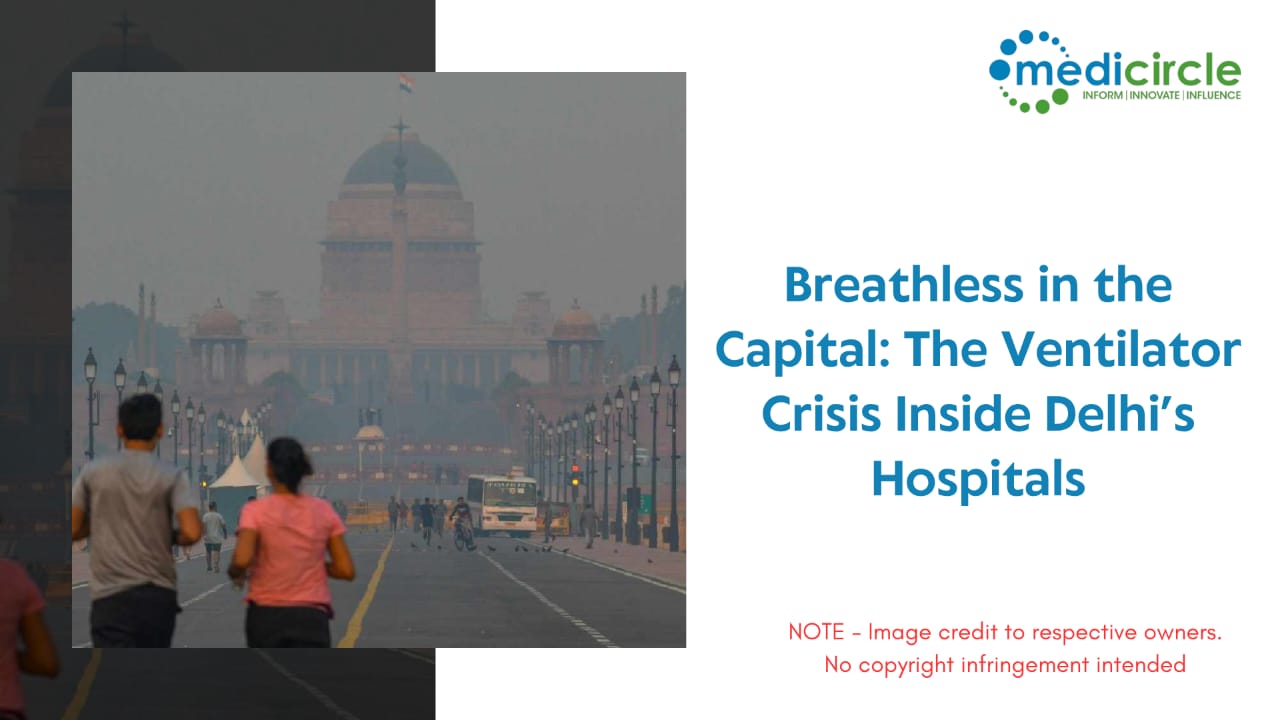
 A healthcare system’s strength is measured not by the number of machines it owns but by how many of them actually work when a life hangs in the balance.




In the heart of the national capital, where some of India’s most prestigious hospitals stand as symbols of modern medicine, a crisis brews behind the white walls and polished corridors. An RTI filed by India Today has brought to light a deeply unsettling truth of nearly one in every three ventilators across major Delhi hospitals, including Maulana Azad Medical College (MAMC) and its associated Lok Nayak Hospital, are non-functional. For a city that shoulders the healthcare burden of millions, this revelation raises a fundamental question about the state of critical care infrastructure in India’s capital.
The RTI findings, submitted by Delhi’s Health Minister Pankaj Singh, showed that out of 297 ventilators across key hospitals such as MAMC, Lok Nayak, Deen Dayal Upadhyay, Lal Bahadur Shastri, and Sushruta Trauma Centre, as many as 92 are lying defunct. That’s nearly 31 percent of life-saving machines standing unused that could mean the difference between life and death for a patient in respiratory distress. At a time when ventilators remain a crucial part of critical care especially in emergencies, ICUs, and during respiratory crises such numbers reflect a worrying gap in hospital readiness and maintenance.
Among the hospitals surveyed, Lok Nayak Hospital which is one of the largest and busiest medical centers in Delhi stands out as the worst affected. Reports indicate that more than 70 ventilators across departments like Anaesthesia, Medicine, and Paediatrics are not in working condition. Even more concerning is the state of equipment provided under the PM CARES Fund during the COVID-19 pandemic. These ventilators, meant to strengthen the critical care infrastructure in times of crisis, are now collecting dust. The RTI revealed that at least 41 ventilators supplied under the PM CARES initiative are currently defunct.
At Lok Nayak Hospital, the situation in Ward 32, all 12 ventilators are non-functional, and in Ward 31, all eight are out of service. These wards, which cater to some of the most vulnerable patients, are now forced to rely on alternative arrangements or referrals, potentially delaying critical interventions. What’s worse, the RTI report mentions that the files for Annual Maintenance Contracts (AMC) have not even been processed for these units, leaving the fate of these machines hanging in bureaucratic limbo.
The problem, however, is not uniform across all institutions. Some hospitals have managed to maintain better operational efficiency. Deen Dayal Upadhyay Hospital reported that all its 25 ICU ventilators are functional, while Lal Bahadur Shastri Hospital has only one faulty ventilator out of 13. The Sushruta Trauma Centre too fared relatively better, with 12 of its 14 ICU ventilators working. But even within these hospitals, the situation varies sharply across departments. For instance, in Sushruta’s Emergency Unit, only two out of seven ventilators are operational i.e. a mere 29 percent functional capacity in one of the most critical hospital zones.
In MAMC, the Department of Obstetrics and Gynaecology has maintained high functionality, with 39 out of 41 ventilators working i.e. an impressive 95 percent. Yet, in the same institution, the Emergency ICU tells a different story, where 11 out of 21 ventilators are defunct. This brings the operational capacity down to less than half, a dangerous statistic for a hospital that handles hundreds of critical patients daily.
The Medicine Department’s situation appears equally grim. Out of 25 ventilators in the Cardiac Care Unit (CCU), 14 are reported non-functional, leaving only 44 percent capacity. The Paediatrics Department has 31 ventilators, of which seven are down, meaning roughly 23 percent of its machines are not working. The most severely affected are the general medicine wards (27–32), where 41 out of 67 ventilators have stopped functioning leaving barely 39 percent operational. For patients in these wards, this could mean waiting for equipment that may not arrive in time.
Adding another dimension to this crisis is the MRI equipment shortage. Both Lok Nayak and Govind Ballabh Pant hospitals have just one functional MRI machine each. These are major tertiary-care centers that cater to thousands of patients daily, and a single functional MRI scanner cannot possibly meet such enormous diagnostic demand. Patients, therefore, are often forced to seek private facilities, adding to their financial strain.
While the RTI paints a serious picture of non-functional machines, Delhi Health Minister Pankaj Singh has attempted to downplay the situation. He acknowledged the RTI report but insisted that, on the ground, most ventilators are functional. “Our latest report shows that out of a total of 74 ventilators in LNJP Hospital, 69 are fully functional. In the Trauma Centre, all six ventilators are working, and 18 are kept as backup,” the minister said in response. He further invited the media to visit hospitals with him to see the situation firsthand, asserting that discrepancies may exist on paper but not in practice.
However, such explanations fail to address the systemic issue of the lack of preventive maintenance and poor documentation practices that have plagued government hospitals for years. Even if some machines are kept as “backup,” the absence of proper AMC files and functional verification raises serious questions about accountability. Ventilators are not devices that can be left idle; their calibration, sterilization, and software systems require regular upkeep. When maintenance lapses occur, the risk of malfunction increases exponentially, especially when the machines are needed the most.
The mention of PM CARES ventilators adds a politically charged layer to this issue. During the pandemic, thousands of ventilators were procured through the PM CARES Fund to strengthen hospitals across India. Yet, several reports from various states have surfaced over the past two years, citing technical faults, lack of compatible consumables, and absence of trained technicians to operate them. Delhi’s RTI findings further reinforce this nationwide problem of a gap between procurement and actual utilization.
For a city like Delhi, which experienced the brunt of the COVID-19 crisis with oxygen shortages and overflowing ICUs, the idea that dozens of ventilators are now lying unused is deeply concerning. Beyond the immediate concern of defunct equipment lies a larger narrative about how India handles its medical infrastructure. Hospitals often receive machines through central or state grants, but there is little follow-up on maintenance. Once the equipment is installed, the responsibility of service contracts, spare parts, and calibration often becomes a bureaucratic maze. Departments cite funding delays, vendors complain about unpaid contracts, and in the middle of this cycle, critical care units end up functioning below capacity.
The RTI revelations should ideally serve as a serious reminder. Delhi’s healthcare system has always been positioned as one of the most advanced in the country, attracting patients from across northern India. However, numbers like these suggest that beneath the surface, even the capital’s hospitals are struggling to maintain the backbone of modern critical care i.e. functioning machines. The issue extends beyond ventilators. It’s about a system where maintenance often comes as an afterthought, and patient safety depends on the luck of which ward a person is admitted to.
Healthcare experts argue that this is precisely where policy must evolve. Maintenance should be built into the budgeting process as a mandatory expense, not as a postscript. Every machine, especially life-support systems like ventilators, must have a clear tracking mechanism, a performance log, and a service accountability trail. Without this, India risks repeating the same mistakes seen during the pandemic of having infrastructure on paper but not in practice.
The government’s response, while assuring, should ideally translate into ground-level audits. A simple verification visit can reveal the truth whether these ventilators are truly functional or just recorded as “in reserve.” Technology could help here; digital dashboards that track the real-time operational status of critical hospital machinery can make healthcare infrastructure transparent and accountable.
The real tragedy in this story is the human side of it. Behind every defunct ventilator is a patient who might lose the fight against respiratory failure because help wasn’t available in time. A family waiting outside an ICU, hoping for a machine to become available, doesn’t care about paperwork or AMC delays they care about survival. Every non-functional ventilator is a story of potential loss, and that should be enough reason to act with urgency.
The RTI findings, though disheartening, open an important conversation. It is not about blaming one hospital or one government; it is about accepting a nationwide challenge that demands systemic change. India’s healthcare infrastructure is expanding, but sustainability must be at its core. Machines that save lives cannot be treated as inventory they are the heartbeat of hospitals.
Delhi, as the capital of the nation, should set an example in healthcare governance. Transparency, timely maintenance, and regular equipment audits should become non-negotiable standards. The capital has the expertise, the resources, and the institutions capable of leading this change. What it now needs is a consistent mechanism to ensure that machines meant to save lives do not go silent due to neglect.
As the debate continues over the accuracy of the numbers, one truth remains clear that a healthcare system’s strength is measured not by the number of machines it owns but by how many of them actually work when a life hangs in the balance. For every patient fighting for breath, a non-functional ventilator is more than a technical glitch, it’s a symbol of a system that must do better.





.jpeg)
.jpg)
.jpg)
.jpg)
.jpg)
.jpg)
.jpg)







.jpeg)

.jpeg)


.png)