
Ghost Faculty, Fake Records, and a Crisis of Trust: Why Pharmacy Colleges in India Face an Existential Reckoning

▴ Ghost Faculty, Fake Records
Every duplicate record, every fake attendance sheet, and every ghost teacher is an assault on the trust that binds society to its healthcare providers.

Hello! If you're looking for high-quality genericmedications, fast delivery and excellent customer service, ourstore is the right choice for you. With over 20 years of onlineexperience, we guarantee safe, effective products that are alwaysin stock. Delivery within 48 hours, free shipping from $200, and 100% money-back guarantee if your order doesn't arrive on time.

👉 Order now at BestCheapPills and discover exclusive discounts for registeredcustomers!
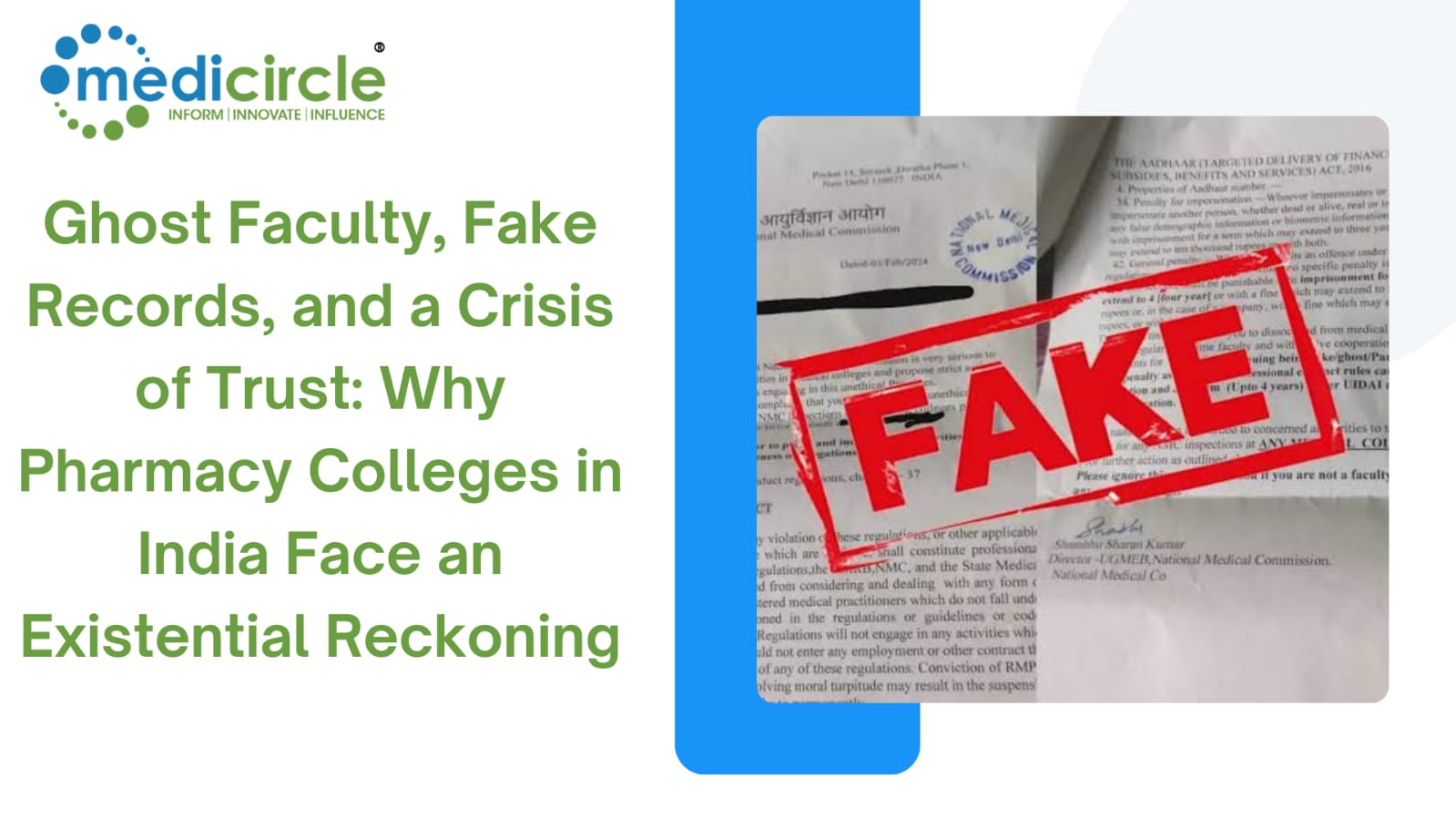
Pharmacy education in India stands today at a crossroads, and the choices made in the next few weeks may determine not just the future of thousands of students, but the credibility of an entire profession. The Pharmacy Council of India, the statutory body under the Ministry of Health and Family Welfare, has sounded the alarm over one of the most unsettling scandals in higher education. Fake records, ghost faculty, and deliberate data manipulation that threaten to erode trust in pharmacy degrees. In response, the council has issued a 15-day ultimatum to all pharmacy colleges, directing them to implement the Aadhaar Enabled Biometric Attendance System (AEBAS). The warning is clear: institutions that fail to comply risk losing their approvals, a step that could effectively shut them down. This ultimatum is not merely a bureaucratic directive; it is a desperate attempt to restore order and credibility to a system that has long operated in shadows.

The numbers themselves paint a grim picture. Of approximately six thousand approved pharmacy institutions across the country, fewer than half have adopted the biometric attendance system. Faculty registration fares even worse, with only about 12,600 of the nearly ninety-five thousand approved educators on the government’s DIGI-PHARMed portal completing the process. Even more disturbing is the discovery of 45,355 duplicate or invalid faculty profiles, exposing a culture of manipulation and fraud that has taken root. These ghost entries are not minor clerical errors; they represent deliberate attempts to game the system, inflate faculty strength on paper, and deceive regulators, students, and society. The Pharmacy Council’s move to make biometric attendance mandatory is designed to end this manipulation by linking every faculty and student presence to their Aadhaar, thereby preventing proxies, fake identities, and false claims.

At its core, this crisis is not just about attendance but about the sanctity of education itself. A pharmacy degree is not a mere certificate; it is a license to serve in one of the most sensitive areas of public life i.e. healthcare. Pharmacists dispense medicines, guide patients, and often act as the first point of contact in India’s healthcare system. If the colleges training these professionals are compromised, the impact flows directly into society, putting lives at risk. When ghost faculty exist only on paper, it means students are deprived of real mentors, laboratories function without qualified guidance, and entire batches graduate without the rigorous training their degree promises. The council’s warning that weak oversight will continue to undermine teaching standards is not an exaggeration but a statement of fact that has been quietly visible for years.

The tragedy lies in how predictable this crisis was. Regulatory bodies have long complained of fake attendance, missing faculty during surprise inspections, and colleges that exist only to churn out degrees rather than pharmacists. Yet enforcement was often patchy, with institutions finding loopholes to continue business as usual. The biometric system, rolled out earlier this year, attempts to close these loopholes by creating a real-time, tamper-proof record. Once fully adopted, it will build a reliable database of educators, eliminating duplicates and ensuring transparency. But resistance from institutions shows how entrenched the old practices are. The reluctance to adopt AEBAS is itself an admission that for many colleges, the façade of compliance was easier to maintain than the discipline of real accountability.

The looming deadline of September 5 is therefore not just a bureaucratic date but a symbolic test of intent. Will pharmacy colleges choose to align with integrity, or will they risk closure by clinging to the shadows? For students, this is a moment of uncertainty. Their degrees, dreams, and careers hang in the balance. Imagine investing years of effort only to discover that your college has lost approval because it failed to comply with basic accountability measures. The damage is not just institutional; it is personal and devastating. Parents who spend their life savings on pharmacy education for their children face the possibility that these sacrifices may be wasted if their wards graduate from unapproved or discredited institutions.

For India’s healthcare ecosystem, the issue is equally critical. A shortage of qualified pharmacists can effect medicine distribution, especially in rural and semi-urban areas where pharmacists often substitute for doctors. If the credibility of pharmacy education collapses, the pipeline of trusted professionals weakens, leaving gaps that no quick fix can fill. The Pharmacy Council’s tough stance reflects an understanding of this wider danger. By linking accountability directly to institutional survival, it forces colleges to confront their own complicity. It is a reminder that education is not a business of numbers and approvals but a trust between teacher, student, and society.

There is also a broader lesson for regulators across other health professions. The struggle with ghost faculty and fake records is not unique to pharmacy. Medical, dental, and nursing colleges have all faced similar issues, with inspections revealing absent professors, manipulated data, and proxy staff hired only during audits. The adoption of biometric attendance could serve as a blueprint for other councils, showing that technology can enforce honesty where manual oversight repeatedly fails. Linking attendance with Aadhaar may seem like a small administrative step, but it is, in fact, a transformative move that could redefine accountability in Indian higher education.

Yet, implementation alone is not enough. Technology is only as effective as the will to enforce it. If penalties are watered down, deadlines extended indefinitely, or loopholes quietly reopened, the biometric mandate will become just another forgotten reform. What is required is sustained vigilance, transparent reporting, and a willingness to act against powerful institutions that flout the rules. Closing a non-compliant college may seem harsh, but allowing it to continue undermines the future of every student it admits. The credibility of pharmacy education must take precedence over the convenience of institutions that treat compliance as optional.

In many ways, this crisis is a mirror reflecting larger questions about the purpose of education in India. Are colleges built to impart knowledge and produce competent professionals, or are they factories of degrees designed to profit at any cost? The answer lies in how the system responds now. By enforcing AEBAS and cleansing the rolls of fake faculty, the Pharmacy Council has taken a bold step. But unless society demands integrity as a non-negotiable value, the problem will resurface in new forms. The fight against ghost faculty is symbolic of a deeper battle against the ghosts of apathy, corruption, and negligence that haunt Indian education.

As the September deadline approaches, one truth stands out that pharmacy education cannot afford to gamble with credibility. A degree that does not rest on genuine learning is a betrayal not just of students but of every patient who will one day trust their health to a pharmacist. The time for half measures has long passed. India needs pharmacists who are not products of manipulated systems but professionals molded by rigorous training, ethical mentorship, and honest institutions. The biometric attendance mandate is the first step in that direction. Whether the colleges comply willingly or are forced into compliance will decide if pharmacy education in India can reclaim its integrity or continue to drift into irrelevance.

The spectre of ghost faculty may seem like an internal problem of educational institutions, but in reality, it is a national concern, a public health issue disguised as an administrative failure. Every duplicate record, every fake attendance sheet, and every ghost teacher is an assault on the trust that binds society to its healthcare providers. The ultimatum given by the Pharmacy Council of India is therefore not just a regulatory order; it is a call to rescue a profession from decline. The coming weeks will reveal whether that call is answered with courage or drowned in silence.

Tags : #PharmacyEducation #FutureOfPharmacy #HealthcareEducation #PharmacistIntegrity #PharmaStudents #GhostFaculty #EducationReform #HigherEducationCrisis #AccountabilityInEducation #CleanEducation #BiometricAttendance #AEBAS #DigitalCompliance #EdTechReform #TechForTransparency #TrustInHealthcare #PatientSafetyFirst #PublicHealth #DigitalIndia #EducationPolicy #PharmaCouncil #IndiaHealthcare #ReformingEducation

Related Stories

Loading Please wait...

-Advertisements-


Trending Now

Cholesterol Explained: Good vs Bad Cholesterol and What It Means for Your HeartJuly 11, 2026
Role of Technology in Hospitals: How Indian Healthcare is Being ReshapedJuly 11, 2026
175 years after ancestors left UP, Indo-Trinidadian infant receives rare liver transplant at Apollo DelhiJuly 10, 2026
Fortis Escorts Faridabad Strengthens Advanced Care Ecosystem with Launch of: Fortis Cancer Institute Institute of Neurosciences Centre of Excellence in Critical Care and ECMOJuly 10, 2026
India’s first focused health AI Conclave unites doctors and AI expertsJuly 10, 2026
University of Leeds Opens Applications for MSc Biotechnology with Business Enterprise for Indian StudentsJuly 10, 2026
How Doctors Are Changing the Face of Indian HealthcareJuly 10, 2026
Medical Innovations to Watch in 2026: How Technology Is Reshaping Healthcare in IndiaJuly 10, 2026
Government of India Notifies Polymatech Electronics’ Semiconductor and Electronic Components SEZ at Nava Raipur, ChhattisgarhJuly 09, 2026
Iswarya Fertility Center Raises Over INR 350 Crore from OrbiMed AsiaJuly 09, 2026
Happiest Health Announces Launch of Speciality Clinics Happiest Paediatrics, Happiest Orthopaedics, Happiest Gynaecology, Happiest Endocrinology & Your Personal PhysicianJuly 09, 2026
Cetaphil launches new AM/PM Antioxidant Serum Duo in India July 09, 2026
THIP Partners with ISSRF to Launch Digital Patient Education Programme for EndometriosisJuly 09, 2026
Blood Tests Everyone Should Understand: A Complete Guide for Indian AdultsJuly 09, 2026
CT Scan vs MRI: Understanding the Difference and Choosing the Right Diagnostic Imaging TestJuly 09, 2026
Robotic Surgery in Modern Urology and Gynecology: Precision, Recovery, and SafetyJuly 08, 2026
Apollo Hospitals Gives Filipino Twin Brothers a New Lease of Life Through Rare Twin Liver TransplantsJuly 08, 2026
Fibroheal Raises ₹14 Crore to Fuel Next Phase of Growth and Entry in Developed MarketsJuly 08, 2026
Veda Rehabilitation & Wellness Opens Himalayan Mental Health Recovery Retreat in Sikkim for Addiction Recovery and Mental WellbeingJuly 08, 2026




















