Tuesday, October 27, 2026
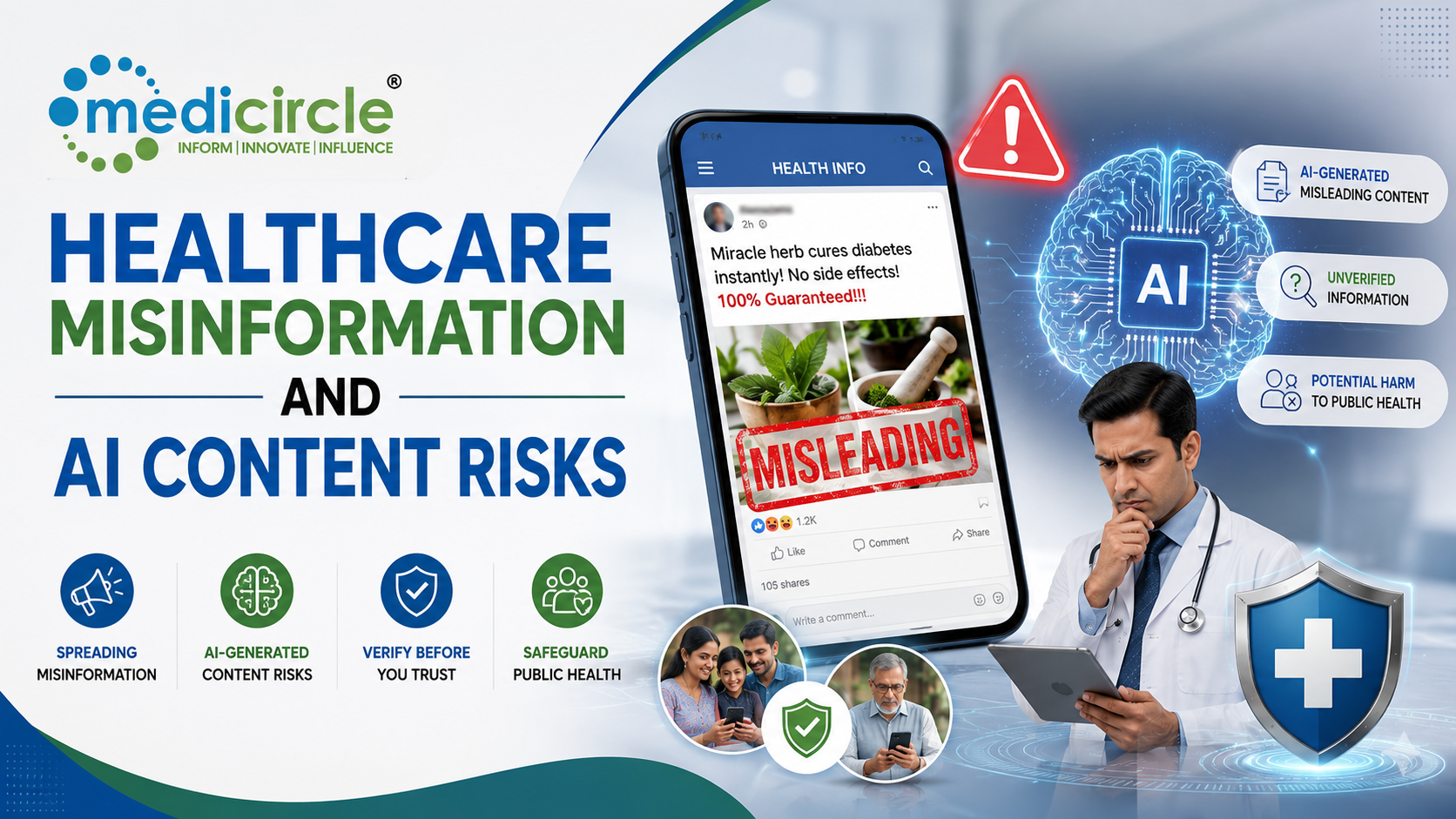
 Healthcare misinformation and AI content risks highlight the growing importance of digital health literacy, critical evaluation, and responsible information use. Understanding how AI-generated content, online health information, and evolving healthcare communication interact helps individuals make more informed decisions in a rapidly changing digital landscape.




Healthcare information has never been more accessible. A student researching symptoms, a parent searching for treatment options, an entrepreneur building a health platform, or a patient looking for answers can find thousands of articles, videos, social posts, and AI-generated responses within seconds. Yet this abundance of information has created a new challenge: determining what is accurate, trustworthy, and safe.
Healthcare misinformation and AI content risks are becoming increasingly important as artificial intelligence generates health-related content at unprecedented scale. While AI can improve access to information, it can also amplify errors, outdated guidance, misleading interpretations, and oversimplified medical advice. Understanding how these risks emerge is essential for making informed decisions in a rapidly changing digital environment.
Why Healthcare Misinformation Has Become More Difficult to Detect
Healthcare misinformation is not a new phenomenon. False medical claims existed long before the internet. However, the digital era has changed both the speed and scale at which information spreads.
In the past, medical information was typically filtered through healthcare professionals, academic institutions, and established publishers. Today, information can reach millions of people through social media platforms, blogs, video channels, and AI-powered tools within hours.
The challenge is that misinformation rarely appears obviously false. Many inaccurate claims contain partial truths, outdated studies, misunderstood statistics, or anecdotal experiences presented as universal facts. This makes misinformation difficult to identify, especially for individuals who lack specialized medical knowledge.
The situation becomes even more complex because health topics often involve uncertainty. Two people with similar symptoms may require different treatments. Recommendations may change as new evidence emerges. As a result, content that appears convincing may not be appropriate for a particular individual or situation.
This environment creates a growing need for digital health literacy. The ability to evaluate information sources, understand context, and recognize uncertainty is becoming just as important as accessing information itself.
How AI Changes the Creation and Distribution of Health Content
Artificial intelligence has dramatically transformed content production. AI systems can summarize research, generate articles, answer questions, create educational materials, and personalize information for users.
These capabilities offer significant benefits. AI can make healthcare knowledge more accessible, simplify complex topics, and help people find information more efficiently. Students can learn faster, healthcare businesses can improve communication, and patients can gain better understanding of medical concepts.
However, AI systems operate differently from human experts. They generate responses based on patterns in data rather than direct understanding of human health.
Several factors contribute to AI content risks:
- AI may present uncertain information with high confidence
A response can sound authoritative even when underlying information is incomplete, outdated, or contextually inappropriate. This confidence often makes inaccurate content more persuasive than it should be. - Training data may contain inaccuracies or conflicting viewpoints
AI systems learn from large datasets that may include outdated medical advice, low-quality sources, or contradictory information. As a result, generated content can unintentionally reproduce existing misinformation. - Complex health situations are difficult to generalize
Healthcare decisions often depend on age, medical history, lifestyle, genetics, and other factors. AI-generated content may simplify these complexities and provide guidance that lacks necessary context.
Understanding these limitations does not mean avoiding AI. Rather, it highlights the importance of using AI as a support tool rather than a substitute for professional judgment.
The Psychology Behind Why Health Misinformation Spreads So Quickly
One of the most misunderstood aspects of healthcare misinformation is that people rarely share false information intentionally. Most individuals believe they are helping others.
Human psychology plays a major role in the spread of inaccurate health content. People naturally seek certainty when facing health concerns. A simple explanation often feels more reassuring than a nuanced one.
For example, a headline promising a quick solution to a common health problem may attract far more attention than a detailed explanation discussing multiple contributing factors. This preference for simplicity creates opportunities for misleading content to gain visibility.
Emotional triggers also influence sharing behavior. Content that creates fear, hope, surprise, or urgency often spreads faster than balanced educational information.
AI-generated content can unintentionally amplify these tendencies because algorithms often prioritize engagement. When engagement becomes the primary objective, accuracy may receive less attention than visibility.
This creates a cycle where highly engaging content gains more exposure regardless of its quality. Over time, repeated exposure can make information feel true even when evidence is limited.
Real-World Risks for Patients, Students, and Businesses
Healthcare misinformation affects different groups in different ways. The risks extend beyond individual health decisions and can influence education, business operations, and public trust.
Patients and General AudiencesPatients often search online before consulting healthcare professionals. While self-education can be valuable, misinformation may lead to unnecessary anxiety, delayed treatment, or misunderstanding of symptoms.
For example, common symptoms can sometimes be associated with multiple conditions. Oversimplified content may encourage individuals to draw conclusions without considering alternative explanations.
Students and ResearchersStudents increasingly rely on digital resources and AI tools during learning. While these technologies can improve efficiency, inaccurate information may affect academic understanding.
A student who repeatedly encounters misleading content may develop misconceptions that become difficult to correct later. This is particularly important in health-related disciplines where accuracy is essential.
Entrepreneurs and Healthcare BusinessesHealthcare organizations face growing pressure to produce educational content quickly. AI tools can support content creation, but excessive reliance on automation may introduce factual errors or reduce credibility.
Businesses that publish inaccurate health information risk damaging trust with audiences, customers, and professional communities. In healthcare, trust is often one of the most valuable assets an organization possesses.
Recognizing High-Quality Health Information in the AI Era
As information becomes more abundant, evaluating quality becomes increasingly important.
Several characteristics often distinguish trustworthy healthcare content from misleading material:
- Reliable content acknowledges uncertainty when appropriate
Health information rarely provides universal answers. High-quality content explains limitations and recognizes that outcomes may vary between individuals. - Evidence matters more than popularity
A widely shared claim is not necessarily accurate. Trustworthy information is supported by research, expert consensus, and transparent sources rather than engagement metrics alone. - Context is included rather than ignored
Accurate health content explains why recommendations differ between people and situations. It avoids presenting complex issues as one-size-fits-all solutions.
These principles help readers approach information more critically without becoming unnecessarily skeptical.
The Emerging Challenge of AI-Generated Authority
One of the most significant AI content risks is the appearance of expertise.
Historically, producing detailed healthcare content required substantial effort and subject knowledge. Today, AI systems can generate large volumes of professional-looking content within minutes.
This changes how authority is perceived online.
Readers often evaluate content based on presentation quality. Well-structured articles, polished language, and confident explanations can create an impression of expertise. However, presentation quality does not guarantee factual accuracy.
As AI-generated content becomes increasingly sophisticated, distinguishing between genuine expertise and automated content may become more difficult.
This does not mean AI-generated content lacks value. Many AI-assisted resources provide useful educational information. The challenge is recognizing that professional presentation should not replace critical evaluation.
Future digital literacy will increasingly involve assessing both the source of information and the process by which that information was created.
Building Better Information Habits for the Future
The most effective response to healthcare misinformation is not fear or avoidance. It is the development of stronger information habits.
People who consistently evaluate sources, compare perspectives, and seek context are better positioned to navigate complex health information environments.
Several practical behaviors support this goal:
- Verify significant health claims through multiple credible sources.
- Distinguish educational information from personalized medical guidance.
- Recognize that AI-generated content may contain limitations.
- Pay attention to publication dates and evolving medical evidence.
- Approach highly emotional or sensational claims with caution.
These habits help create a balanced relationship with digital health information while preserving the benefits of technological innovation.
Why Healthcare Misinformation Will Remain a Long-Term Challenge
Healthcare misinformation is unlikely to disappear entirely. As technology evolves, new forms of content creation, personalization, and distribution will continue to emerge.
AI will likely become more accurate, more accessible, and more integrated into everyday life. At the same time, misinformation strategies may also become more sophisticated.
This ongoing evolution means that critical thinking, digital literacy, and responsible information practices will remain essential skills.
Rather than viewing AI as a threat or a solution, it is more useful to see it as a powerful tool whose impact depends largely on how people use it. Technology can improve healthcare education and access to knowledge, but meaningful understanding still requires human judgment, context, and thoughtful evaluation.
Conclusion
Healthcare misinformation and AI content risks represent one of the most important information challenges of the digital age. As AI expands access to health knowledge, it also increases the need for careful evaluation and responsible use.
The goal is not to distrust technology or avoid digital health information. Instead, it is to develop the skills needed to identify credible sources, understand context, and make informed decisions. In an environment where information is abundant, the ability to evaluate information thoughtfully becomes one of the most valuable health skills anyone can develop.
FAQ (Frequently Asked Questions)
1. How can I identify healthcare misinformation online?Healthcare misinformation often appears convincing because it uses simplified explanations, emotional claims, or selective facts. A good approach is to compare information from multiple credible sources and understand the broader context. Strong digital health literacy and critical thinking skills help people evaluate information more effectively and avoid misleading conclusions.
2. Why is AI-generated healthcare content becoming so common?AI tools can create large volumes of content quickly, making health information more accessible to users worldwide. While this improves access to knowledge, it also increases the importance of health information verification and understanding the limitations of automated content generation. The goal is to use AI as a learning aid rather than a replacement for informed judgment.
3. Can AI-generated medical information be trusted completely?AI-generated health content can be useful, but it should not be treated as a definitive source in every situation. AI systems rely on patterns and available data, which may not always reflect the latest evidence. Applying critical evaluation and maintaining strong digital literacy helps users assess the reliability of information before acting on it.
4. What are the biggest risks of healthcare misinformation for patients?Healthcare misinformation can lead to confusion, unnecessary anxiety, delayed decisions, or misunderstanding of symptoms and treatment options. The long-term health effects of misinformation often arise when people make decisions based on incomplete or inaccurate information rather than evidence-based knowledge.
5. Why do false health claims spread faster than accurate information?People naturally pay more attention to information that creates fear, hope, urgency, or curiosity. As a result, sensational content often receives greater visibility than balanced explanations. Understanding these behavior patterns and improving information awareness helps individuals recognize why some claims gain popularity despite limited evidence.
6. How can students use AI responsibly when researching healthcare topics?Students can benefit from AI by using it to simplify complex concepts and organize information. However, they should also verify important facts through reliable sources and academic references. Combining AI tools with strong research skills and critical thinking practices creates a more accurate learning process.
7. What should businesses know about AI content risks in healthcare marketing?Healthcare businesses increasingly use AI for content creation and communication. While this improves efficiency, it also requires careful review processes to ensure accuracy. Effective content governance and responsible health communication strategies help maintain trust and reduce the risk of spreading inaccurate information.
8. How does healthcare misinformation affect public trust?When people repeatedly encounter conflicting or inaccurate health information, confidence in healthcare systems and information sources can decline. Improving health communication and supporting evidence-based information sharing helps strengthen public trust and encourages informed decision-making.
9. What role does digital health literacy play in preventing misinformation?Digital health literacy helps people understand how to search, evaluate, and interpret health information responsibly. Individuals with stronger literacy skills are better equipped to identify questionable claims, compare sources, and understand context. This makes it one of the most important tools for misinformation prevention.
10. How can individuals adapt to the growing use of AI in healthcare information?The best approach is to remain curious, informed, and adaptable. Understanding both the advantages and limitations of AI helps people make smarter decisions when using digital tools. Building habits around responsible information consumption and health information verification ensures that technology supports better understanding rather than confusion.





-23-300x250.png)

.jpeg)

.jpg)
.jpg)
.jpg)
.jpg)
.jpg)
.jpg)
.jpg)
.jpg)
.jpg)