Tuesday, October 27, 2026
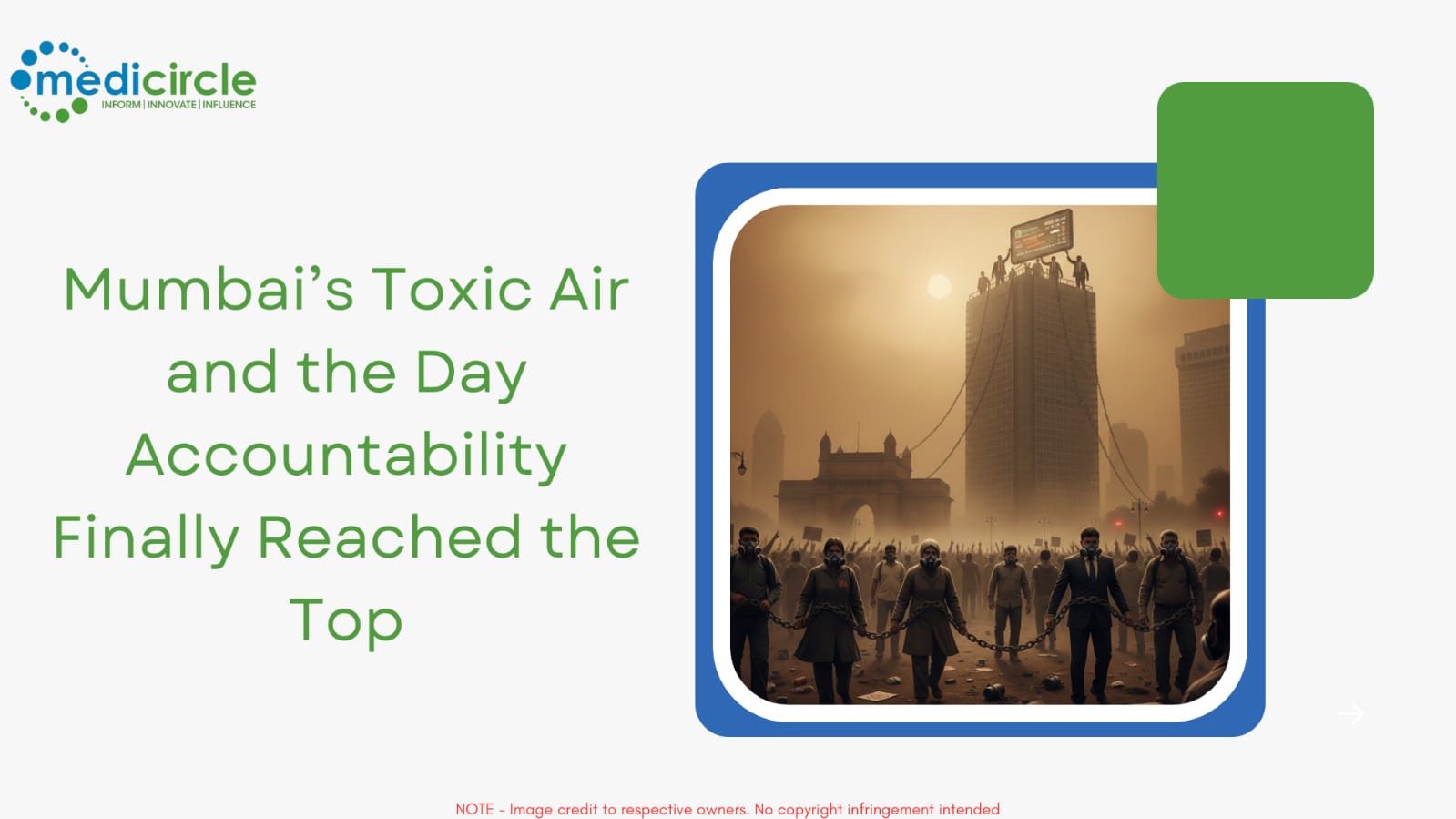
 Mumbai has long prided itself on resilience. It survives floods, rebuilds after tragedies, and adapts to relentless pressure. Yet resilience should not mean endurance of avoidable harm.




There are moments in public life when frustration spills out of files and affidavits and enters the open courtroom. One such moment unfolded recently in the Bombay High Court, when the judges made it clear that Mumbai’s air pollution crisis had crossed from administrative failure into moral negligence. The air in the city, thick with dust, exhaust, and construction debris, was no longer just an environmental issue. It had become a question of accountability, urgency, and the basic right to breathe.
For years, Mumbai’s residents have lived with a compromise. They step out each morning knowing the air will sting their throat, irritate their eyes, and settle invisibly into their lungs. Children go to school with inhalers in their bags. Senior citizens avoid morning walks they once cherished. Runners push through marathons under hazy skies, trusting official air quality numbers that often feel disconnected from what their bodies sense. The discomfort has been normalised, and with normalisation has come silence. What broke that silence was not another alarming pollution reading, but a sharp rebuke from the judiciary.
The Bombay High Court’s criticism of the Brihanmumbai Municipal Corporation and the Navi Mumbai Municipal Corporation was not delivered in polite bureaucratic language. It was direct, impatient, and deeply telling. The judges made it clear that the civic authorities had failed to show genuine intent in controlling rising air pollution levels across Mumbai and its neighbouring areas. The court observed that action seemed to begin only after judicial intervention, raising a troubling question: if courts had not stepped in, would the city’s air have continued to deteriorate without resistance?
In an extraordinary move, the bench indicated that it might stop the salaries of the municipal commissioners if meaningful action was not taken. This was not a symbolic warning. It was a signal that public office comes with personal responsibility, and that environmental neglect is not a distant policy lapse but a lived harm affecting millions each day. When the court asked what the authorities had been doing over the past six months, the silence was louder than any affidavit.
Air pollution in Mumbai is often discussed with comparisons. Delhi is frequently used as the benchmark of what not to become. This comparison has allowed a dangerous comfort to settle in. Mumbai’s air may not always reach Delhi’s hazardous peaks, but that does not make it safe. Pollution is not a competition of extremes. Long-term exposure to moderately poor air quality can be just as damaging, especially in a densely populated city where vulnerable groups are everywhere. Children with developing lungs, older adults with chronic illnesses, pregnant women, and daily wage workers who spend long hours outdoors all pay the price quietly.
Medical professionals have long warned that air pollution is not an abstract threat. It aggravates asthma, worsens chronic obstructive pulmonary disease, increases the risk of heart attacks, strokes, and lung infections, and is increasingly linked to cognitive decline and poor pregnancy outcomes. Hospitals in Mumbai see seasonal spikes in respiratory complaints, yet these patterns rarely trigger emergency-level civic responses. Pollution has been treated as background noise rather than a public health emergency.
What angered the court was not just the data, but the attitude. The judges pointed out that affidavits were being filed casually, responsibilities delegated casually, and compliance treated as optional until court pressure mounted. When the Navi Mumbai Municipal Commissioner failed to file a personal affidavit as directed, and instead sent a city engineer’s response that the court found unsatisfactory, it was seen as more than procedural indifference. The words used by the bench reflected deep displeasure, describing the conduct as a disregard for court orders. In that moment, the issue was no longer just polluted air. It was polluted governance.
The court’s remarks carried a truth that resonates with citizens i.e officials do not breathe a different air. They live in the same city, drive on the same roads, and send their families into the same environment. The idea that enforcement happens only after judicial orders suggests a system that reacts rather than protects. Issuing hundreds of notices to construction sites days before a hearing does not reflect sustained policy. It reflects damage control.
Construction dust remains one of the most visible contributors to Mumbai’s air pollution. Towering sites operate across the city, many flouting basic dust-control norms. Sensor-based air quality monitoring devices, now mandatory, are either absent or disconnected from central dashboards. This is not a technological failure. It is a failure of enforcement. When hundreds of sites operate without real-time monitoring, it becomes impossible to claim ignorance. The data gap itself becomes evidence of neglect.
Senior advocates appearing before the court argued for individual accountability, a concept that has long been missing from environmental governance. When roads develop potholes, specific officers are increasingly being held responsible. Air pollution, though less visible than a cratered road, causes far more harm. It damages lungs instead of suspensions, hearts instead of tyres. The absence of clear accountability has allowed the crisis to stretch endlessly, with blame diluted across departments and committees.
There is also a troubling mismatch between official air quality readings and lived experience. During large public events, discrepancies between civic data and independent observations raise uncomfortable questions. When runners at a city marathon gasp for breath while official numbers suggest acceptable conditions, trust erodes. Data is meant to guide policy and protect citizens. When it appears selective or inconsistent, it does the opposite.
The court’s insistence that it is not its duty to monitor status reports is a reminder of how governance is supposed to function. Civic bodies exist to anticipate problems, enforce laws, and protect public health. Courts are meant to intervene when systems fail, not replace them. The fact that judges are spending hours reviewing pollution control measures reflects a deeper institutional breakdown.
The suggestion to impose hefty fines on violators, ranging from several lakhs to crores, signals a shift in thinking. Environmental crime has often been treated as a minor offence, penalised lightly and quickly forgotten. Yet the damage caused by pollution is neither minor nor reversible. Strong financial penalties send a message that pollution is not a cost of doing business. It is a violation with serious consequences.
Every rise in particulate matter translates into increased hospital visits, medication costs, missed school days, and lost productivity. Families living near busy roads or construction sites experience chronic exposure that cannot be solved with air purifiers alone. Indoor air quality suffers when outdoor pollution seeps into homes. The burden is heavier on those who cannot afford mitigation tools or healthcare.
Mumbai’s air pollution crisis also raises ethical questions about urban development. Infrastructure growth and construction are often cited as signs of progress. Yet progress that compromises health is a false promise. Cities are meant to enhance life, not shorten it. Sustainable urban planning is not an optional add-on. It is central to public health.
The court’s warning that it will not recall what it has already recorded adds weight to the moment. This is not a passing observation that will fade by the next hearing. It is a marker in the legal record, a line drawn after years of inaction. Whether salaries are eventually stopped is almost secondary. The larger shift lies in the tone. Environmental neglect is being framed as dereliction of duty.
The involvement of the Maharashtra Pollution Control Board in the court’s criticism highlights another layer of responsibility. Regulatory bodies exist to enforce standards consistently, not selectively. When pollution levels worsen year after year, it suggests that existing mechanisms are either inadequate or poorly implemented. Seeking extra statutory powers to impose stronger penalties may be necessary, but it also raises the question of why existing powers were not used fully.
For Mumbai, the risk is not becoming Delhi overnight. The risk is slow normalisation of harm. When poor air quality becomes routine, urgency fades. When urgency fades, children grow up thinking breathlessness is normal. Courts stepping in disrupt that complacency.
This moment also reflects a broader shift in public discourse. Air pollution is no longer confined to environmental activists or academic studies. It is entering courtrooms, hospitals, and dinner-table conversations. Citizens are increasingly aware that clean air is not a luxury. It is foundational to health, dignity, and life itself.
Treating pollution-related illnesses places immense strain on already stretched systems. Reducing pollution at the source saves lives without ICU admissions or emergency alerts. It requires political will, administrative discipline, and a willingness to act before courts compel action.
As the next hearing approaches, the real test will be whether civic authorities move beyond compliance theatre. Sustainable solutions demand continuous monitoring, transparent data, strict enforcement, and public communication. They demand that officials see clean air as their core responsibility rather than a seasonal inconvenience.
Mumbai has long prided itself on resilience. It survives floods, rebuilds after tragedies, and adapts to relentless pressure. Yet resilience should not mean endurance of avoidable harm. It should mean the capacity to correct course.
When judges remark that they too are breathing the same air, they echo what millions of citizens feel daily. Air pollution does not discriminate by designation. It settles into every lung equally. The difference lies in who has the power to change it.
If this judicial intervention leads to sustained accountability, it may mark a turning point. Not because salaries were threatened, but because the message became unmistakable. Clean air is not optional. It is not negotiable. And it is no longer acceptable to act only when the court starts holding its breath.
Source: livelaw.in




-23-300x250.png)

.jpeg)






.jpg)
.jpg)
.jpg)
.jpg)
.jpg)
.jpg)
.jpg)
.jpg)
.jpg)