Tuesday, October 06, 2026
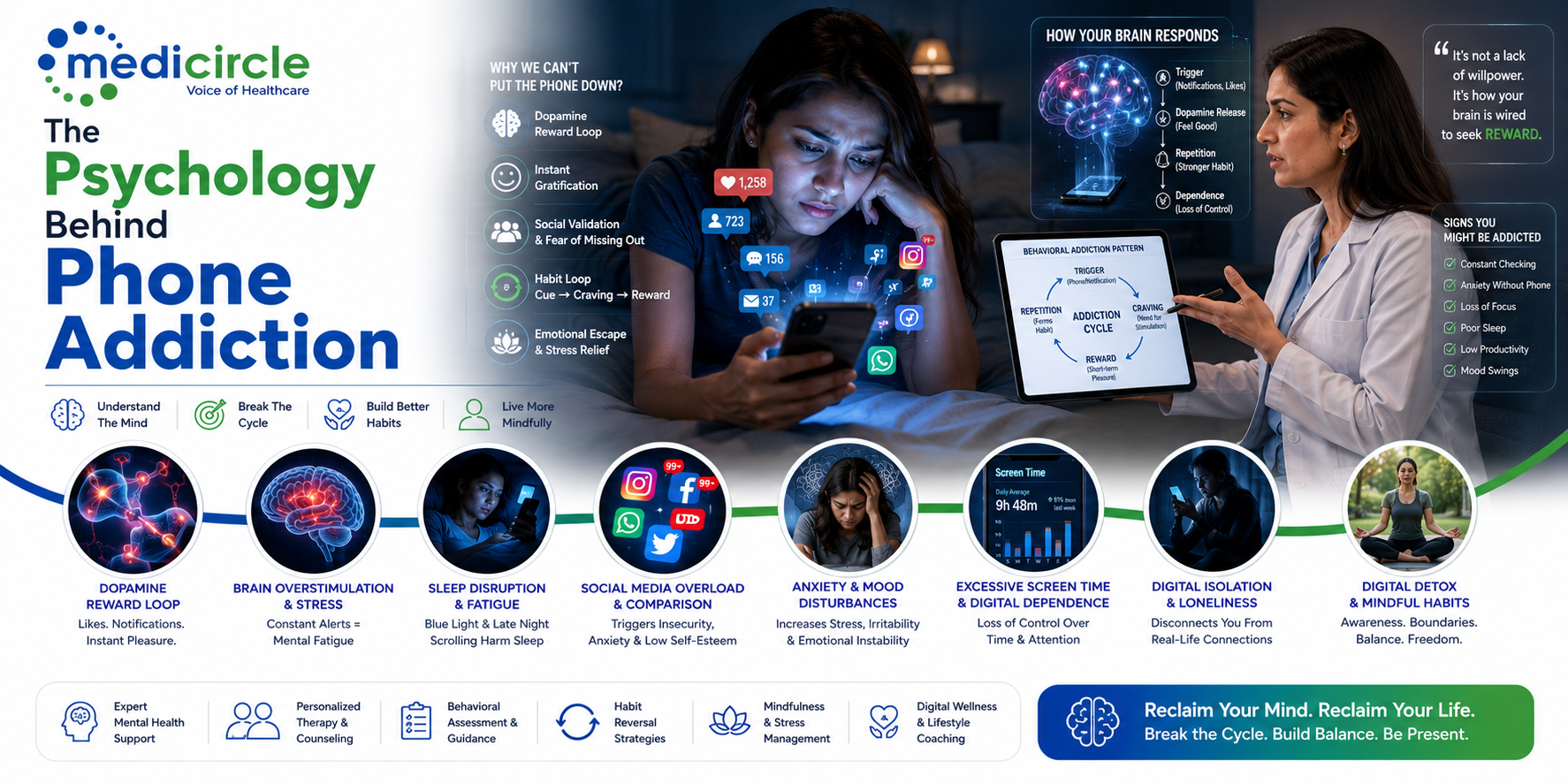
 Phone addiction has become one of the most common behavioral patterns in modern life, affecting attention span, emotional regulation, sleep quality, productivity, and mental well-being. The psychology behind excessive smartphone use is deeply connected to dopamine-driven reward systems, emotional coping mechanisms, social validation, and the design of modern digital platforms.





Most people no longer use their phones only for communication. Smartphones have become emotional regulators, boredom relievers, stress distractors, entertainment systems, social validation tools, and constant companions. For many individuals, checking the phone happens automatically without conscious thought.
This behavior is often described as phone addiction or problematic smartphone use. While not every person with high screen time is clinically addicted, researchers increasingly recognize that excessive smartphone use can closely resemble behavioral addiction patterns involving compulsive checking, reward-seeking behavior, emotional dependence, and reduced self-control. (UTPB)
The psychology behind this habit is not simply about weak discipline. Smartphones are intentionally designed to capture attention through notifications, infinite scrolling, unpredictable rewards, and social feedback systems that strongly activate the brain’s reward circuitry. (Medium)
What Is Phone Addiction?
Phone addiction refers to compulsive smartphone use that interferes with focus, sleep, emotional health, relationships, productivity, or daily functioning. People often describe feeling unable to stop checking notifications even when they know the behavior is unnecessary.
Unlike older forms of technology use, smartphones combine multiple psychologically rewarding systems in one device:
- Social interaction
- Entertainment
- News consumption
- Validation through likes and messages
- Instant information access
- Escape from boredom or stress
This constant availability creates repeated reinforcement loops that train the brain to seek stimulation frequently throughout the day. (UTPB)
A student may unlock the phone to check one message and unknowingly spend forty minutes switching between apps. An office worker may repeatedly check notifications during meetings despite knowing it reduces concentration. These behaviors are not random. They reflect conditioned neurological and psychological patterns.
The Dopamine System and Smartphone Addiction
One of the most important psychological mechanisms behind smartphone addiction involves dopamine, a neurotransmitter associated with motivation, reward anticipation, and reinforcement learning.
Why Dopamine Matters
Contrary to popular belief, dopamine is not simply the “happiness chemical.” Instead, dopamine motivates the brain to seek rewards repeatedly. Smartphones continuously stimulate this reward system through unpredictable digital experiences. (UTPB)
Every notification, message, or new piece of content creates anticipation:
- Someone may have liked a post
- A new video may appear
- An exciting message may arrive
- A trending topic may trigger curiosity
This uncertainty is psychologically powerful because unpredictable rewards activate stronger behavioral reinforcement than predictable ones. Psychologists call this a “variable reward schedule,” the same mechanism used in gambling systems and slot machines. (Medium)
Why Scrolling Feels Endless
Infinite scroll technology removes natural stopping points. Unlike books, newspapers, or television programs that have clear endings, social media feeds continuously generate new stimulation.
The brain remains in a state of reward anticipation:
- “Maybe the next post will be interesting.”
- “Maybe the next notification matters.”
- “Maybe I missed something important.”
This anticipation loop explains why many people check their phones reflexively without even realizing it.
The Emotional Psychology Behind Phone Dependency
Phone addiction is not only neurological. Emotional factors play a major role in excessive smartphone use.
Smartphones as Emotional Escape
Many individuals use phones to avoid uncomfortable emotions such as:
- Stress
- Loneliness
- Anxiety
- Mental fatigue
- Boredom
- Emotional overwhelm
Scrolling temporarily distracts the brain from discomfort. However, this relief is usually short-lived. Once the stimulation ends, stress often returns alongside guilt, exhaustion, or mental fog.
A person may spend hours on short-form videos not because the content is deeply enjoyable, but because the stimulation prevents silence and emotional discomfort.
Social Validation and Digital Approval
Humans naturally seek social belonging. Social media platforms intensify this instinct by attaching measurable feedback to interactions.
Likes, comments, streaks, reactions, and follower counts create small bursts of psychological reward that reinforce repeated checking behavior. (stayawayapp.com)
For younger users especially, digital interaction can become closely tied to self-esteem and emotional reassurance.
This is why:
- Unread messages may create anxiety
- Delayed replies feel emotionally uncomfortable
- Notifications trigger immediate attention
- Social comparison becomes difficult to avoid
Over time, the brain begins associating phone use with emotional regulation itself.
How Phone Addiction Affects Attention Span
One of the biggest concerns surrounding phone addiction is its effect on concentration and cognitive performance.
Continuous Attention Fragmentation
Frequent phone checking trains the brain to switch attention constantly. Every notification interrupts focus and conditions the brain to expect rapid stimulation.
Instead of maintaining sustained attention on one activity, the brain adapts to short bursts of stimulation.
This contributes to:
- Reduced concentration
- Difficulty reading long content
- Mental fatigue
- Increased distractibility
- Reduced deep thinking capacity
- Cognitive overload
Many people now report struggling to complete tasks without checking their phones repeatedly.
A common example is watching television while simultaneously scrolling social media, replying to messages, and switching apps every few minutes. Although the brain feels “busy,” cognitive efficiency often declines.
The Brain Begins Expecting Constant Stimulation
Over time, ordinary activities may begin feeling less engaging compared to digital stimulation. Reading books, having slow conversations, or sitting quietly may suddenly feel unusually difficult.
Some researchers describe this as overstimulation adaptation, where the brain recalibrates its baseline expectations for novelty and stimulation. (Medium)
The Link Between Phone Addiction and Mental Health
Excessive smartphone use has increasingly been associated with mental and emotional health concerns, although the relationship is complex and varies between individuals. (The Guardian)
Anxiety and Mental Fatigue
Constant connectivity creates ongoing cognitive engagement. The brain rarely experiences true mental downtime.
This may contribute to:
- Anxiety fatigue
- Emotional exhaustion
- Mental tiredness
- Sleep disruption
- Cognitive fatigue
- Nervous exhaustion
People often describe feeling mentally overstimulated even during periods of physical inactivity.
Doomscrolling and Emotional Overload
Many individuals consume large amounts of emotionally intense content online, particularly negative news and social conflict. This behavior, often called doomscrolling, keeps the nervous system in a heightened state of alertness.
The result may include:
- Increased stress
- Emotional irritability
- Persistent worry
- Reduced emotional recovery
- Difficulty relaxing before sleep
The brain interprets repeated exposure to distressing information as ongoing environmental threat.
Sleep Disruption and Phone Addiction
Smartphone use significantly affects sleep quality for both neurological and behavioral reasons.
Blue Light and Delayed Sleep
Phone screens emit blue light, which can interfere with melatonin production and delay the body’s natural sleep-wake cycle.
Late-night scrolling also increases mental stimulation when the brain should be transitioning toward rest.
Many people experience:
- Difficulty falling asleep
- Poor sleep quality
- Morning fatigue
- Brain fog
- Daytime sleepiness
Revenge Bedtime Procrastination
Phone addiction is strongly connected to revenge bedtime procrastination, where individuals intentionally delay sleep to reclaim personal time after stressful days.
A person may feel exhausted but continue scrolling for hours because nighttime feels emotionally freeing.
This creates a cycle:
Stress → scrolling → reduced sleep → mental fatigue → more stress.
Signs of Problematic Smartphone Use
Some warning signs of unhealthy phone dependence include:
- Checking the phone automatically without purpose
- Feeling anxious when separated from the device
- Difficulty focusing without interruptions
- Using the phone to avoid emotions
- Losing track of time while scrolling
- Reduced productivity and concentration
- Sleep disruption due to screen exposure
- Feeling mentally exhausted after prolonged use
Experiencing occasional signs does not necessarily indicate addiction, but persistent patterns may suggest problematic digital habits.
Why Young Adults Are Especially Vulnerable
Young adults often experience higher levels of smartphone dependency because modern life increasingly revolves around digital interaction.
Constant Connectivity Culture
Work, education, socializing, entertainment, shopping, and communication all occur through smartphones. Disconnecting may feel socially or professionally difficult.
Algorithm-Driven Attention Capture
Modern apps use sophisticated behavioral design techniques to maximize user engagement. Notifications, personalized feeds, autoplay videos, and infinite scroll systems are engineered to extend screen time. (arXiv)
This makes reducing phone usage psychologically harder than many people realize.
How to Build a Healthier Relationship With Your Phone
Reducing problematic phone use usually works better through gradual behavioral adjustments rather than extreme restriction.
Create Friction Around Phone Use
Small barriers reduce automatic checking behavior significantly.
Helpful strategies include:
- Keeping the phone away during work
- Turning off non-essential notifications
- Avoiding screens during meals
- Charging devices outside the bedroom
- Using grayscale mode to reduce stimulation
Rebuild Attention Span Gradually
Attention improves when the brain practices sustained focus again.
Activities that help include:
- Reading long-form content
- Walking without headphones
- Journaling
- Focused hobbies
- Deep work sessions without notifications
Replace Stimulation With Recovery
Many people confuse stimulation with relaxation. Endless scrolling often leaves the brain more mentally tired rather than restored.
True psychological recovery usually comes from lower-stimulation activities such as conversation, exercise, nature exposure, mindfulness, or adequate sleep.
When Professional Help May Be Useful
If smartphone use significantly interferes with sleep, work, relationships, emotional health, or daily functioning, professional support may help identify underlying contributors.
Problematic smartphone use sometimes overlaps with:
- Anxiety disorders
- ADHD-related impulsivity
- Depression
- Burnout
- Chronic stress
- Social isolation
Addressing the emotional drivers behind compulsive phone use is often more effective than focusing only on screen-time limits.
Conclusion
The psychology behind phone addiction is far more complex than simple lack of discipline. Smartphones interact directly with the brain’s reward systems, emotional coping mechanisms, attention regulation, and social validation needs.
Modern digital platforms are designed to maximize engagement through dopamine-driven behavioral reinforcement, unpredictable rewards, and constant stimulation. Over time, excessive smartphone use may contribute to mental fatigue, reduced concentration, emotional exhaustion, sleep disruption, and cognitive overload.
Understanding these psychological mechanisms is important because healthier digital habits usually develop through awareness and intentional behavioral changes rather than guilt or extreme restriction. Small adjustments in attention management, emotional recovery, screen boundaries, and sleep routines can gradually help restore balance between digital convenience and mental well-being.
FAQs
What is phone addiction?
Phone addiction refers to compulsive smartphone use that interferes with daily functioning, emotional health, concentration, relationships, or sleep patterns.
Why are smartphones so addictive?
Smartphones activate dopamine-based reward systems through notifications, social validation, infinite scrolling, and unpredictable rewards that reinforce repeated checking behavior. (UTPB)
Can phone addiction affect mental health?
Yes. Excessive smartphone use may contribute to anxiety fatigue, emotional exhaustion, stress, sleep disruption, and mental fatigue in some individuals.
What are the symptoms of phone addiction?
Common signs include compulsive checking, reduced attention span, sleep problems, anxiety when separated from the phone, emotional dependence, and difficulty limiting screen time.
Does phone addiction reduce attention span?
Frequent digital interruptions can fragment attention and make sustained concentration more difficult over time.
Why do people keep checking their phones repeatedly?
The brain anticipates potential rewards such as messages, likes, or new content. This anticipation itself reinforces repeated phone-checking behavior.
Can smartphones affect sleep quality?
Yes. Blue light exposure and mental stimulation from scrolling can delay sleep and reduce overall sleep quality.
Is doomscrolling part of phone addiction?
Doomscrolling is a related behavior involving compulsive consumption of distressing or emotionally intense online content.
How can I reduce phone addiction naturally?
Reducing notifications, creating screen-free periods, rebuilding focus habits, improving sleep routines, and limiting nighttime scrolling may help.
When should someone seek professional help for phone addiction?
If excessive smartphone use significantly affects mental health, work performance, sleep, emotional stability, or relationships, professional evaluation may be beneficial.






.jpeg)
.jpg)
.jpg)
.jpg)
.jpg)
.jpg)
.jpg)


.jpg)
.jpg)
.jpg)
.jpg)
.jpg)
.jpg)