Tuesday, October 27, 2026
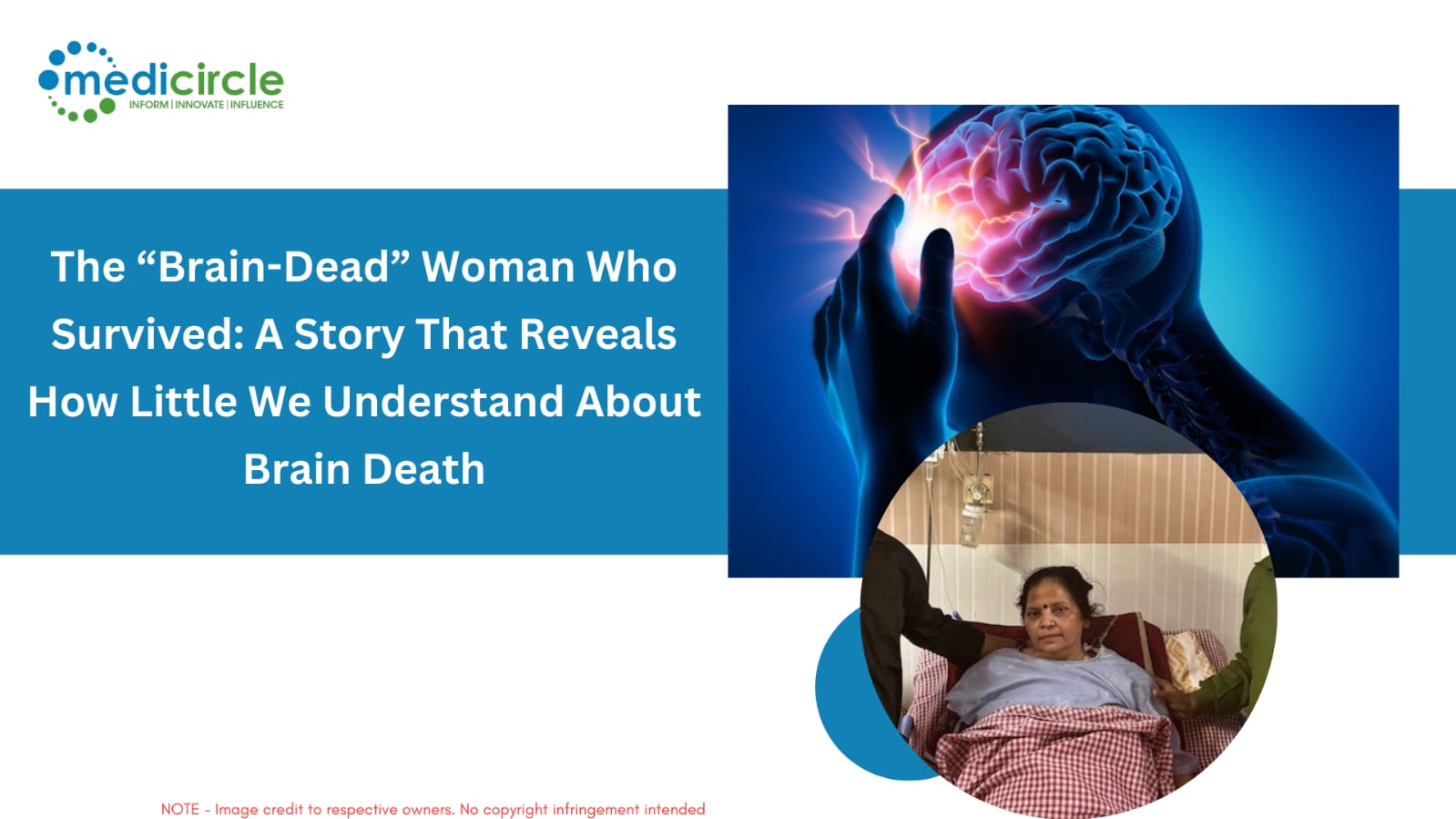
 After weeks of uncertainty, she returned home alive. Her survival has brought relief and gratitude to those who believed they had lost her.




For a few dramatic hours, a story from a small town in Uttar Pradesh captured the imagination of millions across the country. Social media filled with astonished reactions. Headlines hinted at divine intervention. Videos circulated with breathless commentary about a woman who had supposedly returned from death after an ambulance hit a pothole.
In an age where medical science explains most mysteries of the human body, the idea sounded almost supernatural. According to widely shared accounts, a woman believed to be “brain dead” began breathing again while being taken home for her last rites. To many observers, it appeared as if life had returned in the most unexpected moment i.e. during the final journey meant to carry her home for cremation.
But neurologists and critical care specialists say the viral interpretation misses a far more important reality. What happened in Pilibhit was almost certainly not a miracle revival from brain death, because in medical science brain death is irreversible. Instead, the incident highlights a deeply misunderstood concept in medicine which is the crucial difference between brain death and deep coma.
Understanding that difference is not merely an academic exercise. It affects life-and-death decisions in hospitals every day, particularly in cases involving organ donation, critical care management, and end-of-life discussions with families.
The case that sparked the debate involves Vinita Shukla, a resident of Pilibhit district in Uttar Pradesh. According to reports from family members, she suddenly collapsed at home on February 22 and was rushed to a local district hospital. When her condition did not improve, she was referred to a private hospital in the nearby city of Bareilly.
Doctors reportedly informed the family that her condition was extremely critical. For two days she remained unresponsive. She showed no movement, no meaningful reaction, and appeared deeply unconscious. Faced with what seemed like a hopeless situation, the family eventually decided to bring her home.
What happened next would soon become the subject of national fascination.
While transporting her in an ambulance back to Pilibhit, relatives suddenly noticed something unexpected. She appeared to be breathing again. Some reports claimed the moment coincided with the ambulance hitting a pothole, leading to a dramatic narrative that a jolt had somehow revived a “brain-dead” patient.
Instead of continuing home, the family immediately redirected the ambulance to another hospital in Pilibhit. Doctors there admitted her and started treatment. Over the next two weeks, she gradually improved and was eventually discharged.
For her family, the experience understandably felt miraculous. After believing they had lost her, they were suddenly welcoming her home alive. From a human perspective, such moments are bound to be interpreted through the lens of faith and emotion.
For neurologists who study the brain and its functions, the story points to a widespread misunderstanding about what brain death actually means.
In everyday conversation, people often use the phrase “brain dead” to describe anyone who is unconscious or critically ill. In medical science, however, the term has a very specific definition.
Brain death is not simply a severe coma. It is the complete and irreversible loss of all brain activity, including the brainstem i.e. the part of the brain responsible for essential functions such as breathing, consciousness, and reflexes. When brain death occurs, the brain permanently stops functioning. Even if machines maintain circulation or oxygen supply for a short time, the person has legally and medically died.
This definition carries enormous significance in modern medicine. In India, the diagnosis of brain death is governed by the Transplantation of Human Organs Act, which sets strict protocols before doctors can declare someone brain dead.
The process is deliberately rigorous because the declaration has serious implications, particularly in the context of organ donation. Doctors must confirm deep coma, verify the absence of brainstem reflexes, perform a test to determine whether the patient can breathe independently, and conduct examinations by a panel of specialists. Only after these steps are completed twice can brain death be officially certified.
This careful process exists precisely to prevent errors. If a patient later begins breathing or regains neurological function, the conclusion is that they were never brain dead in the first place.
Medical experts believe that something like this likely occurred in the Pilibhit incident. The woman may have been in a state of deep coma or toxin-induced paralysis, conditions that can mimic brain death but may still be reversible under certain circumstances.
This distinction is extremely important because several medical conditions can temporarily suppress brain function to the point where patients appear lifeless. In such situations, pupils may be dilated, reflexes may be absent, and the patient may fail to respond to pain or stimulation.
To an untrained observer and sometimes even to overwhelmed families such a state can appear indistinguishable from death.
Neurologists point out that several factors can produce this kind of medical illusion. Severe drug intoxication, particularly with sedatives or opioids, can deeply depress the central nervous system. Extreme metabolic disturbances, such as severe electrolyte imbalance or low blood sugar, can shut down normal brain responses. Hypothermia, certain toxins, and neurotoxic snake venom can create similar effects.
In some cases, patients may even appear unable to breathe on their own for a period of time.
Doctors involved in the Pilibhit case reportedly suspected snake bite poisoning as a possible explanation. Certain snake venoms contain neurotoxins that temporarily paralyse muscles and suppress the respiratory centre in the brainstem. Victims may become completely motionless and appear lifeless, even though the brain is still alive.
With timely treatment particularly the administration of anti-snake venom, these patients can recover once the toxin gradually clears from the body.
In rural parts of India, such cases are not uncommon during certain seasons. Snakebite remains a major public health issue, particularly in agricultural regions where people may encounter venomous snakes during daily work.
What complicates matters is that toxin-induced paralysis can resemble brain death to families witnessing the scene. The patient lies still, unresponsive, and may appear to have stopped breathing. Without proper neurological testing, the situation can easily be misunderstood.
The viral claim that a pothole “revived” the patient adds another layer of myth to the story. From a neurological standpoint, the idea that a mechanical jolt could restart brain function is highly improbable.
The more likely explanation is simple coincidence.
In cases involving toxins or metabolic disturbances, brainstem functions sometimes begin to recover gradually as treatment starts working or as the body metabolizes the toxin. If this recovery happened around the same time as the ambulance journey, the family may have linked the two events.
Human beings naturally search for dramatic explanations when confronted with unexpected outcomes. The narrative of a pothole bringing someone back to life fits easily into the storytelling instincts of social media. But medical science suggests the real explanation lies in physiology rather than miracle.
Beyond the viral headlines, the Pilibhit case reveals public confusion about brain death and coma.
Even within hospitals, communication between doctors and families about neurological conditions can be challenging. Critical care situations are emotionally overwhelming. Medical terminology can sound frightening or confusing. When relatives hear that a patient is “unlikely to survive,” they may interpret that statement as a declaration of death itself.
In reality, the spectrum of consciousness disorders is far more complex.
Patients may move through several neurological states. Coma represents a deep state of unconsciousness where the patient does not wake or respond. Some individuals later progress into vegetative or minimally conscious states. In rare cases, partial recovery can occur after days or weeks.
Brain death, however, sits outside this spectrum because it represents the complete end of brain function.
The rise of social media has made this challenge even more complicated. Medical events are often reduced to sensational headlines that spread rapidly before experts have a chance to explain the science behind them.
In the Pilibhit story, the phrase “brain-dead woman revived by pothole” traveled quickly across digital platforms. But the phrase itself contains a contradiction in medical terms.
A person declared brain dead cannot return to life because brain death is legally and biologically equivalent to death. This misunderstanding matters for organ donation too.
India faces a chronic shortage of donor organs. Thousands of patients die each year waiting for transplants that could save their lives. Brain death plays a crucial role in this system because organs must be retrieved from donors whose brain function has permanently stopped while circulation is still maintained.
If the public begins to believe that brain death can reverse spontaneously, it may create hesitation around organ donation decisions. Families might fear that doctors are declaring death prematurely, even when strict protocols are followed.
That is why neurologists emphasize that the term “brain death” should be used carefully and only after the formal certification process.
Events like the Pilibhit incident remind healthcare professionals that public education about neurological conditions remains essential. The human brain is extraordinarily complex, and its failure can present in many forms that appear similar but have very different outcomes.
For Vinita Shukla and her family, the ending of this story is unquestionably positive. After weeks of uncertainty, she returned home alive. Her survival has brought relief and gratitude to those who believed they had lost her.
But the real lesson may lie beyond the emotional relief of one family.
The incident reveals how easily medical science can be overshadowed by dramatic narratives. A recovery from deep coma becomes a miracle resurrection. A coincidence during ambulance transport becomes the supposed trigger for revival.
In reality, the story is less about supernatural events and more about the delicate complexity of the human brain.
Medicine continues to uncover how toxins, infections, and metabolic disturbances can temporarily silence brain function without destroying it. In such cases, recovery remains possible with timely treatment and careful monitoring.
But brain death remains fundamentally different. When the brain permanently stops functioning, the body cannot return to life.
For doctors the challenge lies in communicating these truths clearly while respecting the emotional reality families face in moments of crisis.
A woman survived a life-threatening neurological crisis, and that alone is remarkable. Yet the larger question it raises may be even more important: in a world where medical stories spread instantly across digital platforms, how do we ensure that science travels just as fast as sensational headlines?
Because when the difference between coma and brain death is misunderstood, the consequences extend far beyond one dramatic ambulance ride. They shape how society understands life, death, and the fragile boundary between them.





-23-300x250.png)

.jpeg)






.jpg)
.jpg)
.jpg)
.jpg)
.jpg)
.jpg)
.jpg)
.jpg)
.jpg)