 Thursday, October 08, 2026
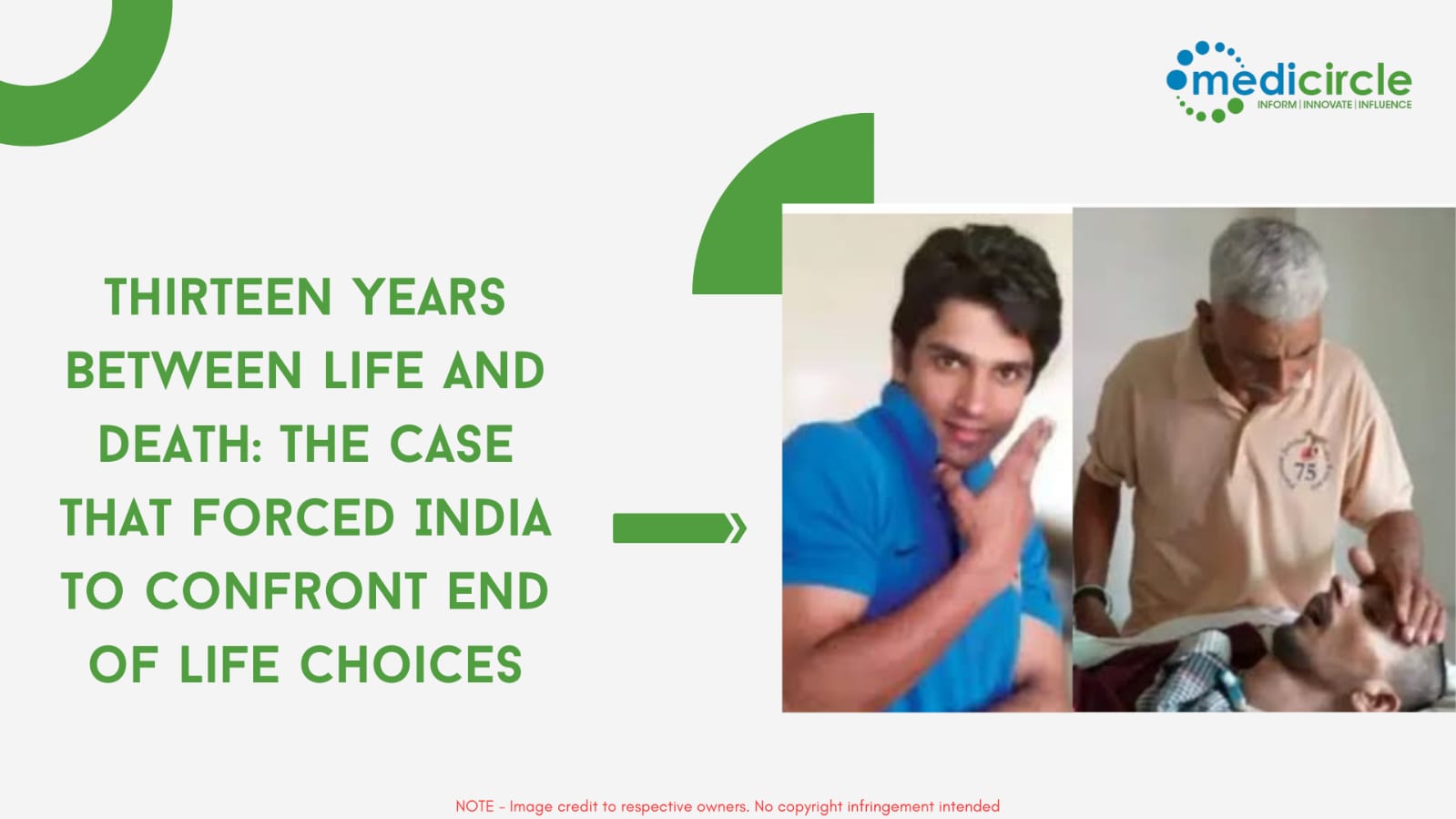
 The story of one young man who never woke up after a tragic accident now reminds the country that advances in medical technology must be matched by equally thoughtful legal and ethical frameworks.




For more than a decade, a young man lay between life and death, breathing through a tube, fed through another, his body sustained by modern medicine while his mind remained absent from the world. Machines were not keeping him alive in the dramatic sense often portrayed in films. His survival depended entirely on clinical intervention i.e. nutrition delivered through a surgical tube, airway support through a tracheostomy, and constant caregiving. In biological terms, he was alive. In human terms, he had long disappeared.
It was this quiet, painful reality that eventually reached the doors of the Supreme Court of India, forcing the country once again to confront one of the most uncomfortable questions in medicine and law: when does preserving life become prolonging suffering?
In a significant ruling, the Supreme Court allowed passive euthanasia for a man who had remained in a persistent vegetative state for thirteen years. At the centre of the decision lies a principle that goes far beyond one individual case. The Court reaffirmed that the right to refuse medical treatment flows from the fundamental right to life and personal liberty under Article 21 of the Constitution of India. A competent person, the Court observed, has the autonomy to decide whether medical treatment should continue or stop. This right arises from the broader principle of self-determination i.e. an idea that places personal dignity at the centre of medical decision-making.
The case became complex because the patient himself could no longer speak, decide, or even show awareness of the world around him. The young man at the centre of the case was once a promising engineering student. In 2013, a tragic fall from the fourth floor of a building caused catastrophic brain damage. Despite extensive treatment at leading hospitals, including advanced neurological care, he slipped into what doctors call a persistent vegetative state. In such a condition, the body continues certain basic biological functions where sleep and wake cycles may occur, breathing can be supported, and reflexes remain but there is no evidence of awareness, cognition, or purposeful movement.
Medical reports over the years painted the same bleak picture. The brain injury was irreversible. Recovery was almost impossible. There was no sign that he recognized voices, responded to pain, or perceived his surroundings. His body survived, but his mind never returned.
For thirteen years, his family cared for him through relentless emotional and financial strain. They pursued treatments, consultations, and every available medical opinion. Eventually, the harsh truth became impossible to ignore: nothing was changing, and nothing was likely to change.
The only reason life continued was because modern medical technology made it possible. A surgically inserted feeding tube provided clinically assisted nutrition and hydration. This method often referred to in medical discussions as CANH delivers liquid nutrition directly into the stomach through a tube known as a PEG tube. It is widely used in patients who cannot swallow but still require nourishment.
In ordinary medical situations, such support is a bridge to recovery. For stroke patients or those recovering from surgery, feeding tubes sustain the body until natural functions return.
But in cases like this, where recovery is medically impossible, the question becomes far more difficult. Is the feeding tube basic care, like giving water to a thirsty person? Or is it a form of medical treatment that can be withdrawn when it no longer serves a therapeutic purpose?
The Supreme Court addressed this question directly. It ruled that clinically assisted nutrition and hydration should be treated as a medical intervention. In other words, it is not merely routine care but a medical procedure delivered through clinical devices. Because of this, doctors and medical boards can evaluate whether continuing such treatment serves the patient’s best interests.
This distinction carries enormous implications. If feeding through a PEG tube is considered medical treatment, then it can be legally withdrawn under certain circumstances particularly when medical experts conclude that the intervention no longer provides any therapeutic benefit.
The Court carefully emphasized that such decisions must be guided by what it called the “best interest of the patient.”
This phrase may sound simple, but it sits at the heart of modern medical ethics. When patients can make decisions themselves, the principle of autonomy dominates. Individuals have the right to choose what happens to their own bodies, including refusing life-saving treatment.
But when patients lose decision-making capacity because of coma, severe brain injury, or advanced dementia, the situation becomes far more complex. Someone else must decide on their behalf.
In the absence of what is known as an Advance Medical Directive or living will, doctors, families, and medical boards must determine what the patient would likely have wanted, and whether continuing treatment serves any meaningful purpose.
The Supreme Court explained that the doctor’s duty to treat a patient continues only as long as treatment offers a reasonable possibility of therapeutic benefit. Once medical science establishes that recovery is impossible and intervention merely prolongs biological existence without restoring consciousness or dignity, the nature of that duty changes.
Continuing treatment under such circumstances does not necessarily serve the patient. Instead, it may prolong suffering or extend a condition that the patient might never have chosen.
The Court made it clear that withdrawing treatment in such cases should not be seen as an attempt to cause death. Rather, it is a recognition that medicine has limits and that forcing the body to survive without hope of recovery may not always be in the patient’s best interest.
This distinction between causing death and allowing death to occur naturally is central to the concept of passive euthanasia.
Passive euthanasia involves withdrawing or withholding medical interventions that artificially sustain life. It differs fundamentally from active euthanasia, where a deliberate action is taken to end life. In India, active euthanasia remains illegal, while passive euthanasia has been permitted under strict guidelines since a landmark judgment in 2018.
The current case builds upon those earlier legal principles while clarifying several unresolved questions.
One of the most important issues raised during the proceedings was the lack of institutional mechanisms for patients who are not in hospitals. The man in this case was receiving home-based care, which meant his family struggled to access the medical boards required under existing guidelines for end-of-life decisions.
This gap forced the family to approach the courts, highlighting a serious structural problem in India’s healthcare system. Many patients with severe neurological injuries remain at home for years, supported by families who bear the full emotional and financial burden. When difficult decisions arise about continuing treatment, there is often no clear pathway for families to seek medical or legal guidance.
The Supreme Court’s observations indirectly exposed this gap. Without robust institutional frameworks, families may feel trapped between compassion, guilt, and exhaustion.
The Court also raised a deeper concern that goes beyond this single case. India still lacks comprehensive legislation governing end-of-life care and euthanasia. The existing framework is based largely on judicial guidelines rather than parliamentary law.
This legislative silence creates uncertainty for doctors, families, and patients alike.
When laws remain unclear, decisions at the end of life can become vulnerable to pressures that have little to do with medical science or patient dignity. Financial hardship, lack of insurance, or the inability to sustain expensive medical care for years may influence choices in ways that are never openly acknowledged.
The Court warned that such circumstances create a dangerous grey zone. A decision that appears to be based on compassion and medical futility might sometimes be shaped by economic exhaustion rather than genuine medical judgment.
India’s healthcare system still places enormous financial strain on families. Long-term neurological care, ventilator support, and specialized nursing can cost lakhs of rupees every year. For many families, sustaining such care indefinitely is simply impossible.
In this context, the absence of clear laws and accessible support systems leaves families navigating morally complex decisions alone.
The Supreme Court’s ruling therefore carries significance far beyond a single patient. It forces a broader conversation about how society understands dignity, suffering, and medical responsibility.
Advances in medical technology have dramatically expanded the ability to sustain life. Feeding tubes, ventilators, dialysis machines, and intensive care units can keep the body functioning for months or years even when recovery is unlikely.
These technologies are among the greatest achievements of modern medicine. Yet they also create ethical dilemmas that previous generations never had to confront.
Before the rise of advanced life-support systems, many severe injuries would have led to death within days or weeks. Today, medical interventions can preserve biological life far longer, sometimes without restoring consciousness or quality of life.
The challenge for healthcare systems across the world is determining how these technologies should be used and when they should be allowed to stop.
Countries like the United Kingdom, Canada, and several European nations have developed clearer legal frameworks for end-of-life care. These frameworks typically include provisions for living wills, advance directives, and medical decision-making by designated guardians.
In India, awareness about advance medical directives remains extremely low. Few people document their wishes regarding life-sustaining treatment in case they become incapacitated. As a result, families often face heartbreaking decisions without knowing what the patient might have wanted.
The case also highlights the emotional toll such situations take on caregivers. Caring for a loved one in a vegetative state for years is physically exhausting and psychologically overwhelming. Families live in a suspended reality neither grieving a death nor witnessing recovery.
Hope fades slowly, replaced by a heavy sense of helplessness. Medical professionals encounter similar emotional conflicts. Doctors are trained to save lives, and withdrawing treatment can feel deeply uncomfortable. Yet medical ethics increasingly recognizes that prolonging biological existence without meaningful recovery may not always align with compassionate care.
The Supreme Court’s judgment acknowledges this delicate balance. It affirms that medicine must respect human dignity, even when that means accepting the limits of treatment.
At the same time, the ruling calls attention to the urgent need for policy reform. India requires clear, compassionate, and transparent legislation governing end-of-life decisions. Such laws must protect patient autonomy while preventing misuse or coercion.
They must also provide accessible institutional mechanisms so families do not have to approach the highest court in the country simply to make deeply personal medical decisions.
Public awareness is equally important. Conversations about death and dying remain uncomfortable in many cultures, including India. Still avoiding these discussions often leaves families unprepared when crisis strikes.
Advance care planning, living wills, and medical directives can help ensure that a person’s wishes are respected even when they can no longer speak for themselves. The Supreme Court’s decision ultimately brings the focus back to a question that modern healthcare systems cannot ignore: what does dignity mean at the end of life?
Is dignity defined by keeping the body alive at all costs, or by respecting the values and autonomy of the individual whose life it is?
Medicine has achieved remarkable power over the human body. But the deeper challenge lies in using that power wisely.
The story of one young man who never woke up after a tragic accident now echoes far beyond the courtroom. It reminds the country that advances in medical technology must be matched by equally thoughtful legal and ethical frameworks. Because the real question is not whether life can be prolonged. In many cases, science has already answered that.
The harder question is whether it should be.
And that answer cannot be found in machines or medical devices. It must come from society’s collective understanding of dignity, compassion, and the right to decide how life should end.






.jpeg)








.jpg)
.jpg)
.jpg)
.jpg)
.jpg)
.jpg)


.jpg)
.jpg)
.jpg)