 Thursday, October 08, 2026
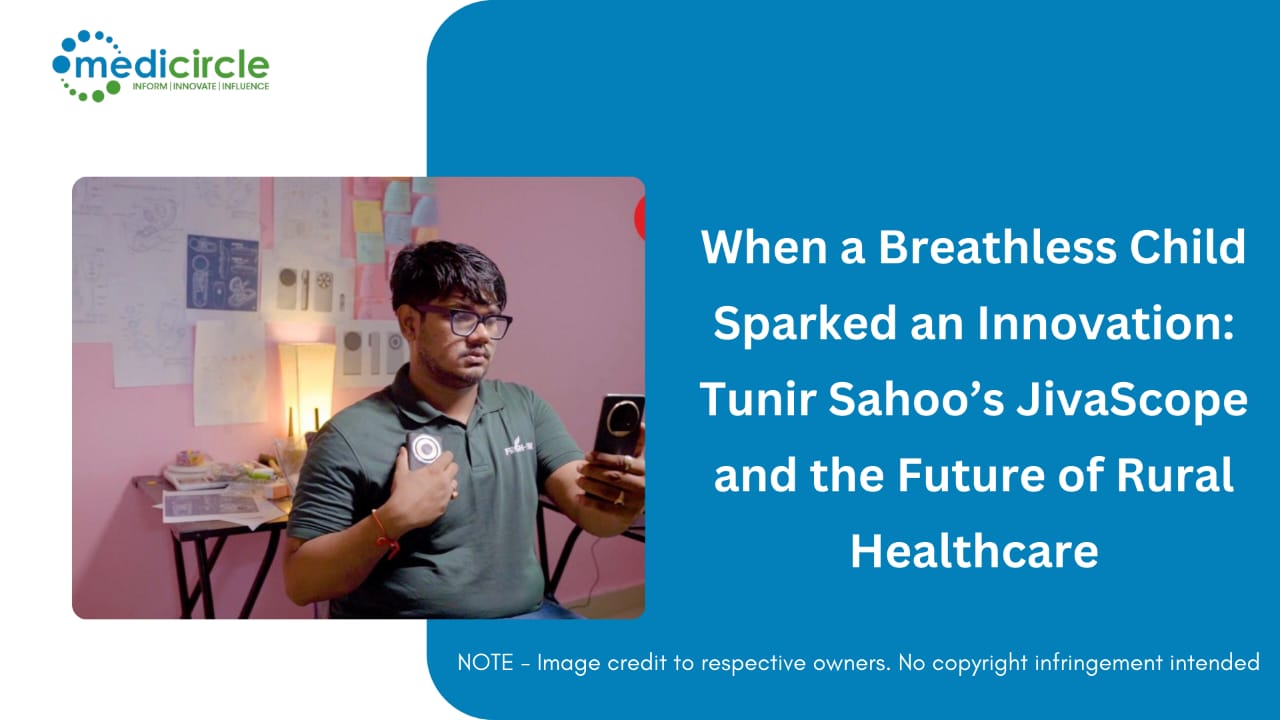
 JivaScope is not just a device. It is a philosophy of healthcare that insists that every breathless child deserves timely diagnosis, no matter where they are born.




In the story of Indian healthcare, breakthroughs rarely emerge from the polished labs of metropolitan cities alone. Sometimes they are born in the dusty waiting rooms of rural clinics, in places where desperation is louder than medicine, and where the absence of technology can decide between life and death. Tunir Sahoo, whose journey from pharmacy to entrepreneurship and finally global recognition speaks not just of invention but of empathy. His creation, JivaScope, a low-cost diagnostic device for pneumonia, is being hailed as a lifeline for rural healthcare and has now brought him the prestigious James Dyson Award 2025, an honour that marks India’s growing contribution to accessible healthcare innovation.
The turning point in his life did not arrive inside the neatly organized classrooms of IIM Kashipur where he pursued his MBA, nor in the academic halls where he studied pharmacy before embracing management. It came in the form of a moment so raw, so real, that it would stay etched forever. In a modest clinic in Bihar, he witnessed a father clutching his young son who gasped for air. The doctor attending to them suspected pneumonia, a disease that can be treated effectively if diagnosed early. Yet, there was no equipment in sight to confirm the condition. The nearest diagnostic facility was hours away, unreachable for the family in both time and money. In that frozen moment, as helplessness replaced hope, Tunir understood that healthcare in rural India was not just about medicines but about access, diagnosis, and timely intervention. That vision gave birth to JivaScope.
JivaScope is a bridge between the sophisticated world of urban medicine and the underserved communities that form the heart of India. Pneumonia kills more children under five in India than any other disease, yet diagnosis often comes too late. In cities, doctors rely on advanced stethoscopes, chest X-rays, and blood tests, but in villages, where most of India’s children live, the reality is harsher. Health workers depend on symptoms like fast breathing, coughing, fever that can overlap with other respiratory illnesses. Misdiagnosis delays treatment, and delays cost lives. Tunir’s innovation answers this critical gap.
The device uses acoustic technology combined with artificial intelligence to detect pneumonia quickly and accurately. It is designed to be simple, portable, and affordable, ensuring that even frontline health workers with minimal training can operate it. The brilliance of JivaScope lies not in being a high-tech gadget meant for big hospitals, but in being a functional, rugged tool that can survive the dust of villages, the chaos of crowded clinics, and the unpredictability of community healthcare settings.
Winning the James Dyson Award has catapulted Tunir and his work into global recognition. The award, known for honouring ideas that solve real-world problems through design and engineering, found in JivaScope a perfect example of innovation driven by necessity. But beyond the award, the real achievement lies in how this device could change lives. Imagine a rural health worker walking into a remote village with JivaScope in her bag. She can now test a breathless child on the spot, confirm pneumonia within minutes, and ensure the right treatment begins immediately. For parents who once had to choose between traveling for hours or watching their child’s condition worsen, this could mean the difference between life and loss.
Tunir’s path is also a story of how pharmacy, business, and empathy converge. With his pharmacy background, he understood disease and medicines. With his MBA from IIM Kashipur, he brought in structured business thinking, scalability, and the ability to design a model that could reach millions instead of hundreds. His entrepreneurial instinct ensured that JivaScope would not remain a prototype admired in journals but a product that could enter the lives of rural families who need it most. And at the center of all this is empathy and the memory of a helpless father, a gasping child, and the conviction that technology should serve the powerless first.
India’s healthcare sector has always been a paradox. On one side, the country produces some of the world’s most skilled doctors, exports affordable generic medicines to over 200 countries, and boasts of cutting-edge hospitals that attract medical tourism. On the other side, rural India, where two-thirds of the population resides, often struggles with basic diagnostic tools. The shortage of doctors, poorly equipped health centers, and lack of reliable technology create gaps that swallow lives silently. Devices like JivaScope are not just inventions; they are interventions that mend the fractured bridge between availability and accessibility.
What makes JivaScope stand out is its focus on affordability. In the Indian context, where healthcare expenses push millions into poverty every year, affordability is as important as accuracy. A device that works well but costs as much as an imported diagnostic tool would serve little purpose. Tunir has worked to ensure that JivaScope remains low-cost, scalable, and deployable in thousands of rural centers without burdening the system. It embodies the idea that innovation in healthcare should be frugal yet effective, cutting through unnecessary sophistication to deliver what truly matters i.e. timely, reliable care.
The James Dyson Award is often associated with futuristic ideas, but JivaScope reminds us that the future of healthcare lies as much in villages as it does in cities. For global audiences, this recognition places Indian innovation in the spotlight. It is not just about exporting medicines and vaccines; it is about exporting ideas that the world can learn from. Pneumonia is not confined to India. It affects millions of children across Africa and Southeast Asia. A low-cost diagnostic device that works in Bihar can work in Uganda, Cambodia, or any low-resource setting where children die of treatable diseases. In this sense, Tunir’s creation transcends borders, making it not just an Indian success story but a global solution.
At a time when discussions around healthcare often revolve around digital platforms, telemedicine, and artificial intelligence in big cities, JivaScope is a reminder that the most pressing challenges remain the simplest ones. A stethoscope that listens better, a device that diagnoses faster, a solution that empowers the village health worker these are the unsung revolutions that truly change lives.
For Tunir, the journey has just begun. Awards are milestones, not endpoints. The real challenge is in scaling production, ensuring regulatory approvals, integrating the device into existing health programs, and convincing governments and NGOs to adopt it widely. The question is not whether JivaScope works but whether the system will allow it to reach the millions who need it. And that is where structured business thinking, partnerships, and persistence will matter most.
As India watches one of its own win global acclaim, the message is clear: the future of healthcare innovation will not always come from the top floors of skyscrapers in Mumbai or Delhi but from the ground realities of rural clinics. It will come from innovators who dare to see the helplessness of a father as more than a tragedy and transform it into a call for action. It will come from blending science with business, empathy with efficiency, and vision with practicality.
In that sense, JivaScope is not just a device. It is a philosophy of healthcare that insists that every breathless child deserves timely diagnosis, no matter where they are born. It is a philosophy that argues that innovation must travel to the margins, where the stakes are highest. And it is a philosophy that dares to imagine an India where no parent loses a child to pneumonia simply because there was no machine to confirm what the doctor already suspected.
The story that began with a father’s helplessness in Bihar has now reached the global stage. But its true ending will not be written in London or New York, where awards are handed out. It will be written in the small villages of India, where a health worker places JivaScope on a child’s chest, hears the sound of lungs, and whispers to the anxious parents “It’s pneumonia, but we caught it in time.” That moment will be the real reward, far greater than any trophy.





.jpeg)










.jpg)
.jpg)
.jpg)
.jpg)
.jpg)
.jpg)


.jpg)