Tuesday, October 06, 2026
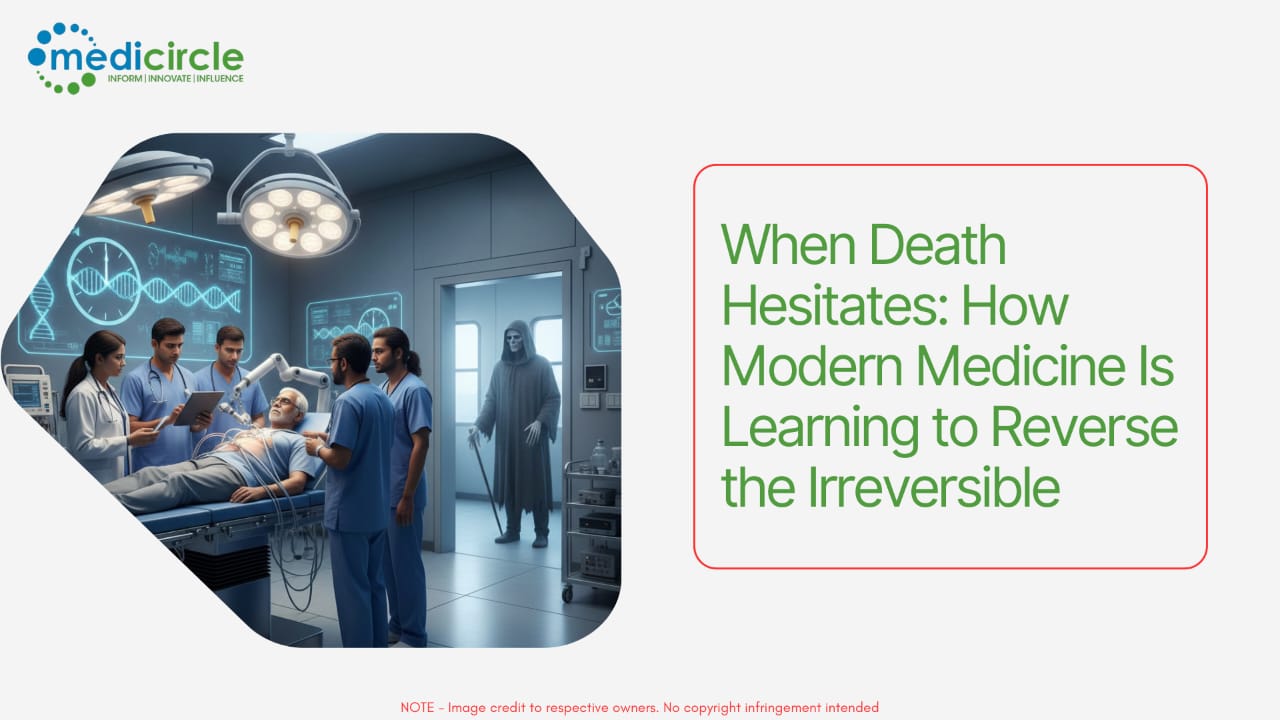
 What becomes clear is that death is not a single moment etched in stone. It is a biological process with stages, thresholds, and opportunities.




For centuries, death has been treated as a single, final moment. A heartbeat stops, breathing ceases, the body cools, and life is declared over. Medicine, law, and even philosophy have been built around this sharp dividing line. Yet, inside research laboratories and academic hospitals, that line is being questioned. Scientists are beginning to show that death is less like a switch and more like a slow fade, a sequence of biological events that unfold over time. In that fragile window, something remarkable may be possible: the partial restoration of life at a cellular level.
At the centre of this scientific shift is a new class of technologies often described as “instruments of life.” These are not defibrillators or ventilators in the traditional sense. They are complex systems designed to restore circulation and oxygen delivery to cells that have been deprived of blood after the heart has stopped. One of the most discussed breakthroughs in this space emerged from a study published in Nature in 2022, where researchers described a system capable of reviving cellular activity in vital organs long after clinical death.
The technology, known as OrganEx, is built on a deceptively simple idea. When blood flow stops, cells do not die instantly. Instead, they undergo a cascade of biochemical failures. Energy production collapses, waste products accumulate, and cell membranes begin to break down. Traditionally, once this process began, it was considered irreversible. OrganEx challenges that assumption by reintroducing circulation using a specially formulated synthetic blood, combined with advanced oxygenation and protective compounds. The aim is not to restart life as we know it, but to halt and partially reverse the damage happening at the smallest unit of the body: the cell.
This approach builds on earlier experiments that shocked the scientific community. In a previous project called BrainEx, researchers circulated a synthetic blood-like solution through the body of a pig that had been dead for an hour. To widespread surprise, cells in the brain, heart, liver, and kidneys began to show signs of renewed activity. Neurons resumed basic metabolic functions. Heart cells responded to stimuli. The organs were not alive in the human sense, but they were no longer inert. They were active, responsive, and functioning at a cellular level.
One of the key scientists behind this work, David Andrijevic, was based at Yale School of Medicine during the study and is now associated with NYU Langone Health. His perspective reflects a shift in how medicine understands death. According to him, the recovery of any organism begins with the recovery of individual cells. If cells remain broken beyond repair, no amount of advanced technology can restore function at a higher level. Cellular health, in this view, is the foundation upon which all recovery must be built.
Yet, this recovery has limits. There is a tipping point, Andrijevic explains, beyond which cells can no longer be salvaged. Once membranes rupture completely and internal structures disintegrate, no intervention can reverse the damage. What makes OrganEx compelling is that it appears to widen the window before this tipping point is reached. Cells do not collapse all at once. They decline in stages, and within those stages lies an opportunity to intervene.
The challenge is that organs are not made of a single type of cell. A kidney alone contains dozens of specialised cell populations, each responding differently to oxygen deprivation and reperfusion. Restoring blood flow itself can be dangerous. When fragile cells are suddenly flooded with oxygen-rich fluid, they can suffer additional injury, a phenomenon well known in emergency medicine. OrganEx attempts to walk this narrow path by carefully controlling oxygen levels and using a synthetic blood formulation designed to protect cells while reviving their core functions.
What this research makes clear is that cellular death is a process, not an instant. This understanding reshapes long-held assumptions in medicine. It suggests that the moment when a person is declared dead may not coincide with the moment when all biological potential has vanished. There is a liminal phase, a biological twilight, where cells are damaged but not destroyed. It is here that modern science is beginning to operate.
Still, restoring cellular activity does not mean restoring life. This distinction is critical and often misunderstood. When scientists revived activity in a pig’s brain, they were careful to clarify that it was not a living brain in the conscious sense. There were no organised brain waves associated with awareness. No perception. No thought. It was a brain with functioning cells, nothing more. Life, as humans experience it, emerges from complex coordination between cells, tissues, organs, and systems. Reawakening one layer does not automatically reassemble the whole.
The brain, in particular, remains the most daunting frontier. More sensitive to oxygen loss than any other organ, it has a shorter window for intervention. Even if cellular function could be restored, the consequences are deeply uncertain. Consciousness itself remains one of science’s greatest mysteries. No one knows whether restoring metabolic activity in brain cells could lead to fragmented awareness or unintended states of experience. The ethical implications are immense. The idea of reviving brain tissue without restoring the body raises questions that medicine has never had to answer before.
Despite these complexities, the motivation behind this research is not rooted in science fiction fantasies of resurrection. It is grounded in a far more immediate and urgent problem of global shortage of transplantable organs. In the United States alone, over 100,000 people wait for organ transplants. Many will die before a suitable organ becomes available. Similar shortages exist across Europe, Asia, and developing regions, including India, where organ donation rates remain low despite growing demand.
Currently, donor organs must be transplanted within a narrow time frame. Once removed from the body, the clock starts ticking. Even with cold storage, organs degrade quickly. This limits matching options, increases emergency procedures, and often forces doctors to discard organs that might otherwise have been usable. Most donor organs also come from older individuals, meaning they are not always in optimal condition at the time of retrieval.
This is where technologies like OrganEx could transform modern medicine. By maintaining organs on perfusion systems for extended periods, doctors could preserve cellular health far longer than is currently possible. More importantly, these systems could become platforms for organ repair. Instead of rushing an organ from donor to recipient, physicians could take time to assess, stabilise, and even improve it.
Future possibilities include using stem cells to repair damaged tissue or transferring healthy mitochondria to rejuvenate energy-depleted cells. These ideas may sound ambitious, but they build directly on what OrganEx has already demonstrated: that cells can be coaxed back from the brink if given the right conditions. Organ preservation could evolve from passive storage to active treatment.
This shift has implications beyond transplantation. It forces a re-evaluation of how death is defined in medical practice. If organs can be restored to function hours after circulation stops, what does that mean for end-of-life decisions, emergency care, and legal definitions of death? These questions do not have easy answers, and researchers are careful not to overstate their findings. The goal is not to blur ethical boundaries but to better understand biology’s true limits.
What becomes clear through this work is that death is not a single moment etched in stone. It is a biological process with stages, thresholds, and opportunities. Understanding those stages could allow medicine to intervene more effectively, saving organs, extending lives, and improving outcomes for patients who currently have no options.
For families waiting anxiously for a transplant call, these advances carry huge hope. Even if technologies like OrganEx never restore a person to life, they could still offer something deeply meaningful. One individual’s final biological chapter might help write a new beginning for another. In that sense, the science is less about reversing death and more about redefining what can still be saved.
Modern medicine has always advanced by questioning assumptions once thought unshakeable. The belief that death is instant and absolute may be the next to evolve. As research continues, the space between life and death is no longer empty or inert. It is active, dynamic, and increasingly understood. And in that narrow space, science is learning how to pause, intervene, and maybe, offer a second chance at life





.jpeg)
.jpg)
.jpg)
.jpg)
.jpg)
.jpg)
.jpg)


.jpg)
.jpg)
.jpg)
.jpg)
.jpg)
.jpg)