 Tuesday, October 27, 2026
 As India observes the aftermath of yet another preventable disaster, one can only hope that this time, the outrage translates into reform.




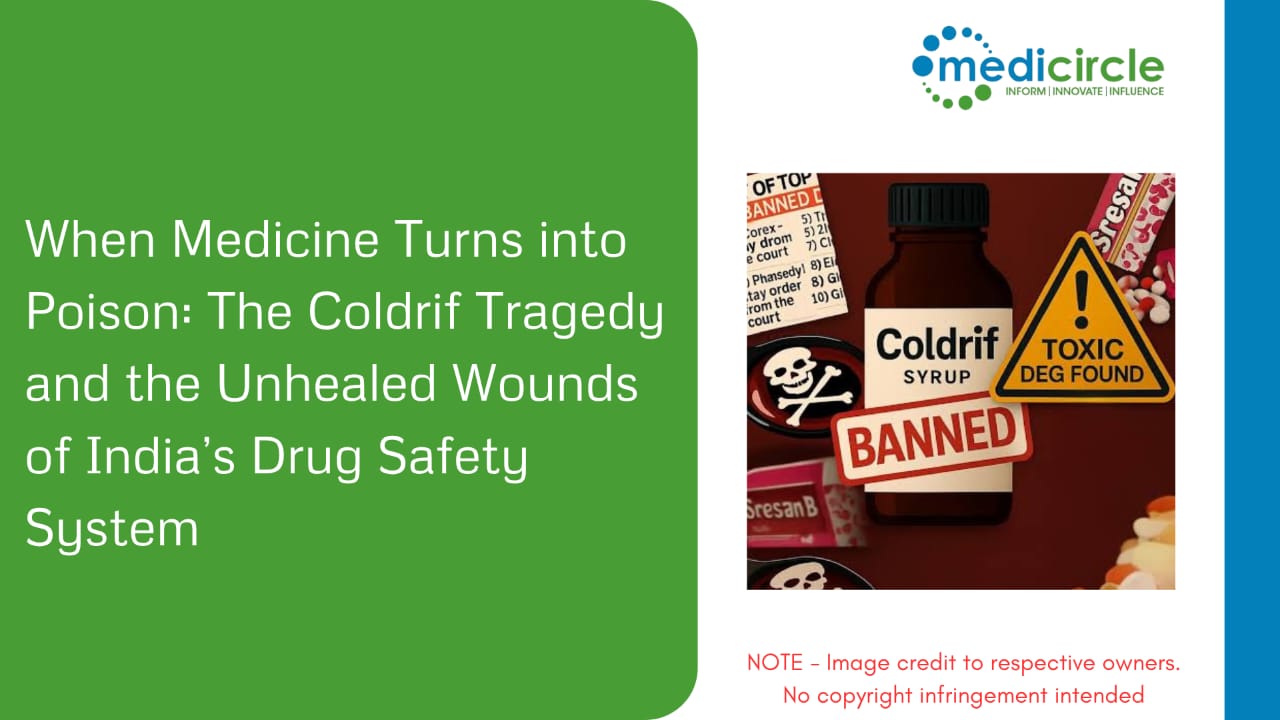
There are few things more tragic than the loss of a child, and even more unbearable when the cause lies in something meant to heal. The recent Coldrif cough syrup tragedy has once again shaken India’s conscience, reminding the nation that the line between medicine and poison can be frighteningly thin when vigilance fails. Twenty-two innocent children lost their lives in Madhya Pradesh after consuming a syrup that was supposed to bring relief, not death. The Tamil Nadu government’s swift decision to revoke the manufacturing license of Sresan Pharmaceuticals came as both a punitive and preventive step, but the damage had already been done. This incident raises grave questions about the cracks within India’s pharmaceutical regulation system that continue to widen with each recurring tragedy.
The Tamil Nadu health department announced that Sresan Pharmaceuticals, the manufacturer of the contaminated Coldrif cough syrup, has been permanently shut down. The factory, based in Kancheepuram district, was producing medicines under a license that should have been routinely inspected and monitored. Yet, the very people entrusted with ensuring safety failed in their duty. The state suspended its drug inspectors in Kancheepuram for not visiting or inspecting the facility since 2022. That gap in oversight now stands as a dark testament to how negligence in supervision can cost innocent lives. The owner of Sresan Pharma, G. Ranganathan, was arrested in Chennai by a special investigation team from Madhya Pradesh, marking a rare instance of accountability in a system often marred by slow reactions and bureaucratic red tape.
The story began unfolding when Madhya Pradesh’s drug authority detected contamination in the Coldrif syrup following the deaths of children in Chhindwara district. The Tamil Nadu government, upon receiving the alert on October 1, immediately launched its own investigation. Laboratory analysis revealed horrifying results: the syrup contained 48.6% Diethylene Glycol (DEG) which is 486 times the permissible limit. DEG and its counterpart, Ethylene Glycol, are industrial chemicals that have no place in human medicine. They are toxic to the kidneys and can cause acute renal failure, neurological complications, and death.
The tests found that the batch had been manufactured using non-pharmacopoeial grade propylene glycol, an excipient that is supposed to act as a harmless solvent in cough syrups. Instead, it turned out to be the very ingredient that carried the poison. The contamination was so severe that even a small dose could prove fatal for a child. Tamil Nadu officials immediately issued a stop-production order to the company on October 3 and a notice demanding explanation within ten days. By October 5, the government had banned the sale and distribution of the syrup across the state and informed the Union Ministry of Health, as well as the governments of Odisha and Puducherry, where the syrup had been distributed.
The tragedy has reignited discussions on India’s drug manufacturing standards and the lapses that keep reappearing despite repeated national and international embarrassments. It is not the first time India has faced such horror. In recent years, the nation’s reputation as the “pharmacy of the world” has taken severe blows after similar incidents surfaced in Gambia, Uzbekistan, and Cameroon, where children died after consuming Indian-made syrups contaminated with DEG and Ethylene Glycol. Each time, the outrage rises, promises are made, committees are formed, and yet the cycle repeats. The problem is not a lack of rules, but the lack of enforcement, accountability, and ethical vigilance in production and quality control.
Every layer of India’s drug regulatory system from state licensing authorities, testing laboratories, to central oversight agencies, plays a role in ensuring safety. Yet, the Coldrif episode exposes a chain of complacency. The drug inspectors in Tamil Nadu failed to check the facility for nearly two years. The manufacturer allegedly used substandard raw materials. The distribution networks sold the product without adequate scrutiny. The system that should have safeguarded citizens from such products was asleep. In an age where India exports billions of dollars worth of pharmaceuticals globally, it is unacceptable that basic safety checks for domestic production remain inconsistent and neglected.
Health experts say that Diethylene Glycol contamination is not new to India’s pharmaceutical landscape. The first major DEG poisoning case dates back to 1973, followed by others in 1986, 1998, and 2020. The pattern remains disturbingly similar i.e. cough syrups manufactured by small or mid-sized companies using contaminated solvents sourced from unverified suppliers. Often, these firms operate under local licenses with limited technical oversight. The repeated occurrence of such tragedies suggests that lessons are being forgotten faster than they are learned.
What makes the Coldrif case particularly painful is that it targeted children below 12 years of age. Their developing bodies stood no chance against the toxicity of DEG. Parents who trusted the medicine as a cure for a common cough ended up watching their children’s health deteriorate in ways that even doctors could not reverse. The tragedy has shattered faith in the safety of over-the-counter pediatric medications. It has also reignited debates on the ethical responsibility of medical practitioners and pharmacists to ensure prescriptions are scientifically sound.
Kerala’s Health Minister, Veena George, reacting to the incident, reiterated that the state had already banned the sale of Coldrif syrup in its territory and had instructed pharmacies not to dispense pediatric cough syrups without a valid doctor’s prescription. She also mentioned that Kerala has a standing committee to regulate pediatric cough syrup formulations to prevent the inclusion of irrational and potentially harmful combinations. Such steps, while commendable, highlight the fragmented nature of India’s drug safety mechanism where states act independently, often after tragedies, instead of in a coordinated national effort aimed at prevention.
The arrest of Sresan Pharma’s owner is a step toward justice, but justice alone cannot undo the loss of lives. What India truly needs is a stronger system of drug surveillance that functions before and not after tragedies occur. Routine inspections of manufacturing units, random quality checks of finished products, and stringent penalties for non-compliance must become the rule, not the exception. The presence of outdated or infrequent inspections, overburdened regulatory bodies, and lack of technical expertise in local drug control departments continue to make enforcement patchy and reactive.
There is a pressing need for India’s pharmaceutical sector to embrace transparency and digital accountability. Every batch of medicine must be traceable from the raw material supplier to the end distributor. Integrating AI-based monitoring and blockchain verification can ensure real-time tracking of drug quality and prevent contamination from slipping through the cracks. Public access to verified data on licensed manufacturers and quality test results can build confidence and discourage malpractice. The Central Drugs Standard Control Organisation (CDSCO) must also step up its coordination with state drug authorities, ensuring that gaps like those seen in Tamil Nadu do not persist.
This incident also calls for introspection within the pharmaceutical industry. The race for profit, when combined with inadequate supervision, can lead to corner-cutting in quality control. Pharmaceutical ethics must be as strictly guarded as the formulations themselves. Manufacturers should view compliance not as an administrative burden but as a moral obligation.
Public awareness too plays a crucial role. Consumers often buy syrups and medications over the counter without understanding their contents or checking their sources. In India, where self-medication is common, strengthening public education about safe drug use is essential. Parents must be made aware that pediatric cough syrups should never be administered without medical supervision. Pharmacists must resist the temptation to dispense drugs without prescriptions, especially to children. Enforcement must go hand in hand with education to bring about lasting change.
Globally, the World Health Organization (WHO) has expressed concern over recurring cases of contaminated syrups in developing countries, urging governments to strengthen their regulatory mechanisms. The Coldrif case may yet again bring international scrutiny to India’s pharmaceutical exports, affecting not just public health but the nation’s credibility in global trade. For a country that prides itself as the supplier of affordable medicines to the world, these lapses cast a long shadow over decades of goodwill built by responsible manufacturers.
The sorrow of the families in Madhya Pradesh cannot be captured in numbers or reports. Each child lost is a story of unfulfilled dreams and unanswered questions. Their deaths should serve as a wake-up call, not just for Tamil Nadu or Madhya Pradesh, but for the entire country. It is time for India to decide whether it wants to be known for cheap medicines or safe medicines. Affordability must never come at the cost of safety.
The revocation of Sresan Pharmaceuticals license and the suspension of negligent officials are steps in the right direction, but they are not enough. Accountability must extend to every link in the chain from raw material suppliers to drug controllers. The government must strengthen the infrastructure of drug testing laboratories, invest in training for inspectors, and mandate stricter compliance audits. Such reforms must be swift, systemic, and uncompromising.
When medicine turns into poison, it’s not just a manufacturing failure it’s a moral one. It reflects how far we have drifted from the essence of healthcare, which is to heal, protect, and preserve life. The Coldrif tragedy is not an isolated event it is a mirror reflecting the weaknesses within India’s drug regulation and healthcare governance. Until those weaknesses are fixed, every bottle on a pharmacy shelf carries a question mark, every prescription a silent doubt.
As India observes the aftermath of yet another preventable disaster, one can only hope that this time, the outrage translates into reform. Because every life lost to negligence is a wound on the nation’s conscience that no medicine can ever heal.




-23-300x250.png)

.jpeg)







.jpg)
.jpg)
.jpg)
.jpg)
.jpg)
.jpg)
.jpg)
.jpg)
.jpg)

