Tuesday, October 27, 2026
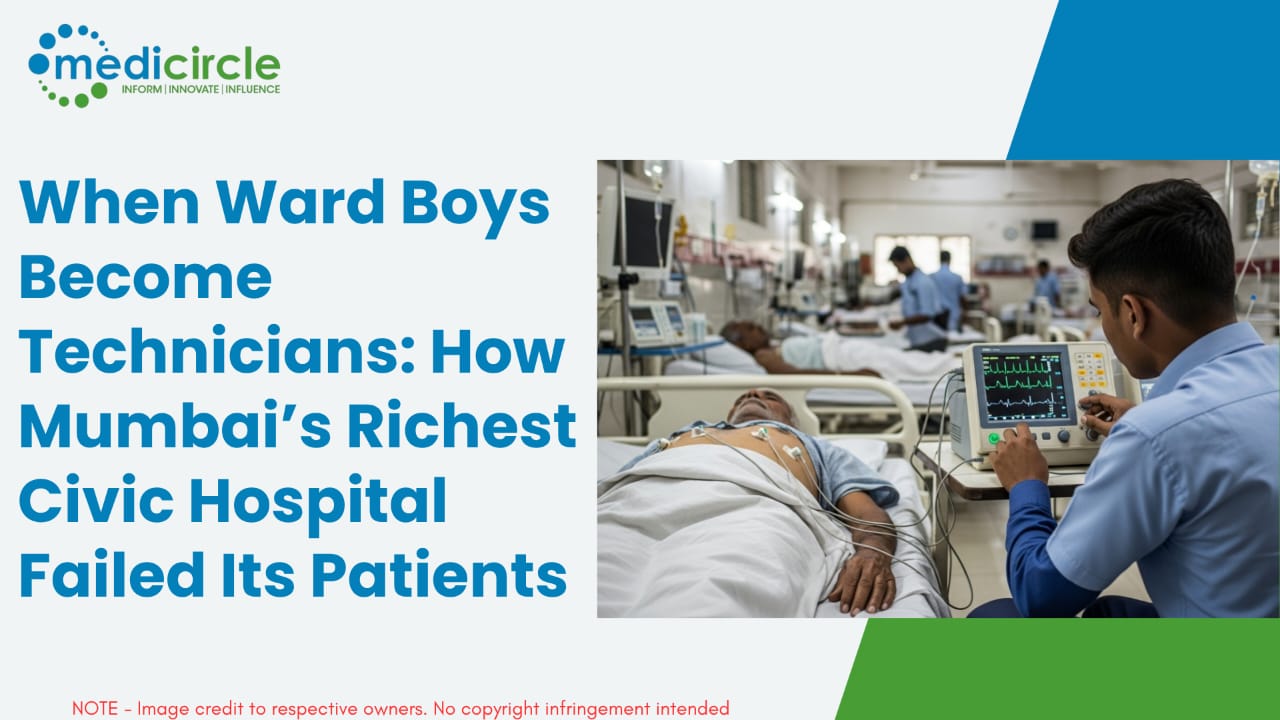
 Human rights are not abstract ideals but living guarantees that every patient deserves safety, every hospital owes accountability, and every act of negligence carries a human cost too heavy to ignore.




In a city that prides itself on being India’s financial capital, where skyscrapers pierce the clouds and hospitals boast of cutting-edge healthcare, an unsettling reality has surfaced from the heart of Mumbai’s civic health system. The Brihanmumbai Municipal Corporation (BMC), often celebrated for being the richest municipal body in the country, has come under criticism after the State Human Rights Commission (SHRC) exposed a disturbing lapse at its own Shatabdi Hospital. The revelation that ward boys were performing ECGs on patients awaiting surgery is not just an administrative failure; it is a breach of human trust in the most sacred of spaces i.e. the hospital ward.
The case unfolded after a patient raised a complaint before the SHRC, revealing that at Shatabdi Hospital, sanitation workers were performing electrocardiograms which is a diagnostic test that plays a vital role in detecting heart abnormalities before surgeries. For many, this came as a shock, and for the Commission, it was an appalling disclosure that exposed the negligence embedded in the functioning of a public healthcare institution funded by taxpayers. When the SHRC sought an explanation from the hospital, the reply only deepened the concern. The Chief Medical Officer of the hospital clarified that ECGs were indeed being conducted by “trained employees.” But when the Commission pressed further to understand who these trained individuals were, the shocking answer emerged that they were none other than the ward boys of the hospital, individuals without any formal medical or technical certification for conducting such critical diagnostic procedures.
In its detailed order, SHRC chairperson Justice A.M. Badar expressed grave disappointment, stating that such a situation was unimaginable for a hospital managed by one of the wealthiest municipal corporations in India. The Commission drew a chilling parallel, likening the condition to that of rural areas where “quack doctors” or “jhola chaap” practitioners offer unqualified medical services. For Mumbai, a city where millions depend on government hospitals due to the unaffordable costs of private healthcare, this felt like a betrayal of public faith.
What makes the case more distressing is that this was not an isolated oversight but a structural failure stemming from prolonged negligence. The hospital administration admitted that the post of ECG technician had been vacant for an entire year. In the absence of trained professionals, the hospital had been relying on ward boys to handle ECGs. These individuals, though familiar with hospital routines, lacked the specific training essential to carry out such sensitive medical tests safely. The SHRC, in its observation, stated that “length of service cannot replace technical expertise,” reminding authorities that healthcare, unlike other professions, leaves no room for trial and error. One misreading or mishandling during an ECG could alter a diagnosis or, worse, put a patient’s life at risk.
The SHRC made it clear that healthcare cannot be reduced to a matter of convenience or improvisation. Every test, every diagnosis, and every procedure in a hospital must be conducted by qualified personnel who are trained, certified, and accountable. Allowing untrained staff to perform medical diagnostics is a violation of the patient’s fundamental right to safe treatment protected under the umbrella of human rights. Justice Badar’s words carried the weight of truth and responsibility: “Without training, there cannot be healthcare of requisite quality.” This single line captures the essence of the healthcare crisis when expertise is replaced by makeshift management, patients become victims of a system that prioritizes functioning over safety.
The SHRC’s order was firm and unapologetic. It directed the BMC to immediately ensure that trained ECG technicians are appointed and available at the Shatabdi Hospital. Additionally, the Commission ordered the civic body to pay a compensation of Rs 12 lakh to the Maharashtra State Legal Services Authority (MSLSA) for violating the human rights of patients. The MSLSA, which provides free legal aid to vulnerable sections of society, will now use this compensation to further advocate for the rights of those who cannot afford justice.
For a civic body with an annual budget exceeding that of several Indian states, a shortage of ECG technicians should never have occurred. This incident raises pressing questions about governance, accountability, and the priorities of public health institutions in metropolitan India. How does a hospital in the country’s financial capital fail to recruit a basic technical position for over a year? How can human lives be entrusted to untrained staff in a facility that claims to uphold standards of care?
The tragedy lies in the normalization of such practices. Across many government hospitals in India, shortages of staff, delayed recruitments, and administrative complacency are often brushed under the carpet. The system continues to function, but only superficially, while patients unknowingly bear the risks. A routine ECG, for instance, might seem simple, but it is a critical diagnostic tool that helps doctors identify cardiac irregularities before administering anesthesia or surgery. A wrong lead placement or an inaccurate reading could have serious, even fatal, consequences. The fact that this was being carried out by ward boys, without supervision or certification, is a violation of medical ethics and patient safety.
Healthcare in India has long been caught between public expectation and institutional reality. While private hospitals cater to those who can afford premium care, government hospitals remain the only option for the majority. Citizens enter these hospitals with faith that they will be treated safely and competently. They trust that their lives are in the hands of professionals, not improvisers. When that trust breaks, the consequences reflect far beyond one hospital and weaken confidence in the entire public health system.
Justice Badar’s remarks resonate deeply in this context. He highlighted that even middle-class families cannot afford private hospital care, and thus depend heavily on municipal hospitals for affordable treatment. Such citizens deserve the assurance that they are being cared for by well-trained professionals. When a patient lies on a hospital bed, consent is given not just to a procedure but to the competence of those performing it. The moment that competence is compromised, the right to safe medical care is violated.
The Commission’s observation that this case mirrors the conduct of “quack doctors” reminds the severity of the issue. It’s an indictment of how systemic inefficiency can push even established institutions into unsafe practices. Mumbai’s civic hospitals have often been hailed for their affordability and accessibility, but incidents like this expose the cracks within. Wealth and infrastructure mean little if governance and accountability are weak. The richest municipal corporation in the country cannot justify the absence of trained technicians while ward boys, however sincere, perform duties beyond their expertise.
For many patients, especially those from economically weaker backgrounds, the idea that their ECGs were being handled by untrained staff is both frightening and disheartening. It raises questions about what other areas of healthcare may be compromised. Are there other diagnostic tests being managed by unqualified personnel? Are there checks in place to ensure that every procedure, no matter how routine, is carried out by certified professionals? These are questions the BMC must answer transparently.
The SHRC’s order has set a strong precedent. It has sent a clear message that human rights extend beyond legal and social contexts, they are deeply embedded in the right to safe, ethical, and competent healthcare. Every patient, regardless of their social or economic standing, has the right to be treated by trained professionals. Neglecting this principle is equivalent to neglecting human dignity itself. The Commission’s decision to channel compensation through MSLSA also reflects a broader vision to ensure that the most vulnerable sections of society benefit from the consequences of systemic accountability.
This episode has also reignited conversations around staffing in public hospitals. In a system where bureaucratic delays and funding mismanagement often result in vacant posts and outdated infrastructure, the real victims are patients. Recruitment drives must be proactive, continuous, and transparent. Vacancies for critical technical roles should never be allowed to persist for months, let alone years. The safety of a patient cannot wait for administrative clearance.
The larger issue here is not just about one hospital or one department; it’s about the mindset that allows such negligence to thrive. A hospital should never operate on the principle of “make do.” In healthcare, every small error can translate into a life-altering event. An ECG misread, a wrong medication, a missed signal are not just statistics; they are potential tragedies. When public institutions display such disregard for precision and expertise, it erodes the very foundation of public trust.
The BMC now faces a crucial test to restore that trust. It must act swiftly to ensure that all its hospitals are adequately staffed with qualified technicians, nurses, and doctors. It must review and modernize its recruitment processes to prevent such gaps from recurring. Moreover, it must be transparent in addressing the shortcomings highlighted by the SHRC. The apology is not enough; reform is necessary. The citizens of Mumbai deserve better from an institution that prides itself on being the financial and administrative backbone of the city.
This should not be remembered merely as a case of negligence but as a turning point in the conversation around healthcare accountability in India. The SHRC’s intervention is a victory for patient rights and a warning for complacent systems. It signals that even the richest institutions are not above scrutiny and that the health and dignity of citizens must always come before administrative convenience.
The story of ward boys performing ECGs at Shatabdi Hospital is not just a scandal it is a symptom of a deeper fungus that affects public healthcare across India. It demands need for reform, training, and respect for human life within the system. For now, the SHRC’s voice stands as a reminder that human rights are not abstract ideals but living guarantees that every patient deserves safety, every hospital owes accountability, and every act of negligence carries a human cost too heavy to ignore.




-23-300x250.png)

.jpeg)






.jpg)
.jpg)
.jpg)
.jpg)
.jpg)
.jpg)
.jpg)
.jpg)
.jpg)