 Thursday, October 08, 2026
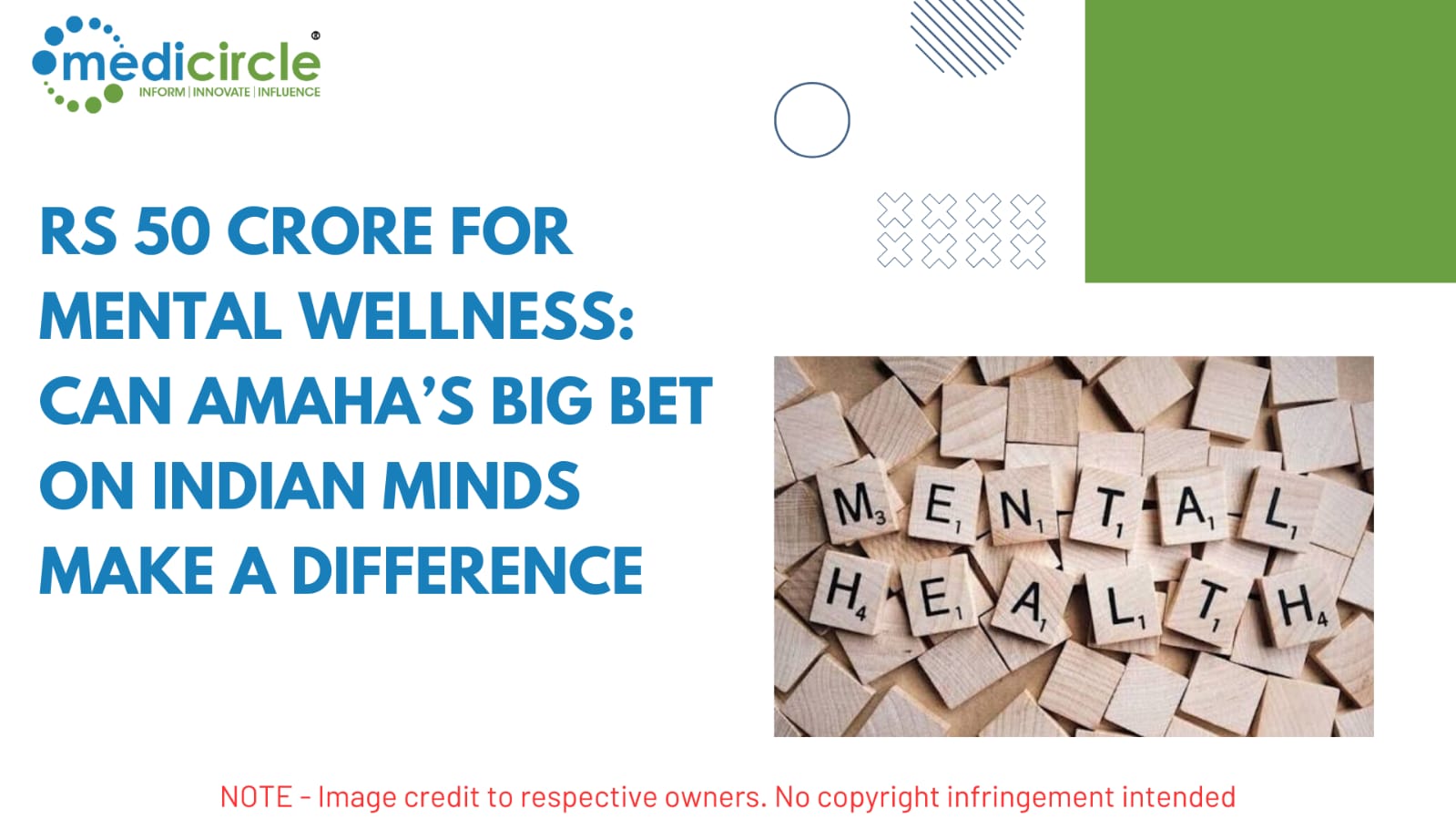
 If Amaha succeeds in achieving profitability while expanding care, it will not just be a win for its founders or investors, but for every patient who finds relief.




There are moments in India’s startup journey that go beyond numbers, valuations, or headlines, and instead strike at the core of what society desperately needs. Amaha Health’s recent fundraising of Rs 50 crore is one such moment. At first glance, it looks like another growth story of a well-backed digital-first healthcare venture. But when you peel back the layers, what stands revealed is a deeper narrative about the rising demand for psychiatry, therapy, and structured mental healthcare in a nation that for too long has treated mental well-being as an afterthought.
The round was led by Fireside Ventures, which brought in Rs 36 crore, while the rest came from a clutch of family offices and angel investors. For a space often described as underfunded and overlooked, this infusion of capital is not just about expanding offices or hiring talent, it is a statement that mental health is finally being acknowledged as a mainstream need. In the words of founder and CEO Amit Malik, who has steered Amaha since its inception in 2016, this is a step toward building a mental health ecosystem that is accessible, affordable, and deeply personalised for India.
When Amaha began, the cultural conversation around mental health in India was tentative, almost whispered. Therapy was seen as indulgence, psychiatry was loaded with stigma, and discussions on depression or anxiety were often confined to hushed corners. Yet, within a decade, the mood has shifted. The pandemic years exposed the fragility of the human mind under uncertainty, isolation, and grief. Younger generations, particularly in urban India, became more vocal about their struggles and more willing to seek professional help. Corporates realised that employee well-being could not be limited to physical health check-ups. Into this shifting landscape, Amaha has carved its place as both a patient-first and institution-focused platform.
The startup today operates three physical centres in Mumbai, Bengaluru, and Delhi-NCR. These are not token clinics, but full-fledged spaces staffed with over 150 psychiatrists and therapists. Unlike fragmented services that often leave patients disoriented, Amaha emphasises continuity of care including psychiatry, therapy, counselling, and support communities under one umbrella. Its workforce, now over 250 employees, represents a growing army of professionals trying to bridge India’s yawning gap in mental healthcare. For perspective, India has less than one psychiatrist for every 100,000 people. Against such a backdrop, scaling structured services is not just a business ambition, it is a public health imperative.
Prior to this round, it had already secured about $10 million from investors like Lightbox Ventures, Capricorn Partners, and Info Edge CEO Hitesh Oberoi. That backing gave it the runway to experiment, build credibility, and diversify its offerings. The acquisition of Children First in 2022 was a strategic pivot that broadened its scope to children and adolescents, perhaps the most vulnerable demographic in the mental health equation. In schools and households across India, children wrestle with issues that range from exam anxiety to identity struggles, from attention disorders to trauma. By bringing these services under its wing, Amaha widened its mission from catering to stressed-out professionals to nurturing India’s future generations.
Interestingly, Amaha has not confined itself to a business-to-consumer model alone. Roughly 20% of its revenue today comes from its business-to-business partnerships with companies like Godrej, Cipla, and Grant Thornton. These collaborations are not just HR add-ons; they represent a shift in corporate culture, where mental health support is becoming a workplace standard. Organisations are learning that burnout, stress, and unresolved psychological issues are silent productivity killers. By embedding mental wellness into corporate programs, Amaha is positioning itself as a partner in long-term workforce resilience.
The company’s stated ambition now is to achieve EBITDA-level profitability in the next 15 to 20 months. For an industry that is still testing sustainable models, this is an audacious but necessary target. Profitability, in healthcare, is often viewed with suspicion, but when it comes to mental health, sustainable financial growth is essential to scaling access. Without financial viability, centres close, therapists churn, and patients lose continuity. With steady revenues and investor confidence, Amaha can deepen its infrastructure, invest in technology, and ensure long-term support for patients.
But what makes this funding milestone more than a corporate update is the symbolism it carries in a country where mental illness still hides in the shadows. According to estimates, nearly 14% of India’s population suffers from some form of mental disorder, and the economic burden runs into billions due to lost productivity. Yet less than 10% of those affected seek professional help. This treatment gap is one of the largest in the world. Every new therapy session delivered, every psychiatrist added to the system, and every stigma shattered moves the needle toward bridging this gap. Amaha’s expansion, therefore, is not merely about scaling a startup; it is about chipping away at a national crisis.
Mental healthcare, unlike other branches of medicine, faces unique hurdles. The barriers are cultural, where silence and denial remain common coping mechanisms. They are infrastructural, given the shortage of trained professionals and the uneven distribution between cities and small towns. They are financial, because therapy is often seen as a luxury, out of reach for lower-income families. And they are regulatory, as India still lacks a fully evolved framework for integrating mental health into primary healthcare. It is in this pool of challenges that ventures like Amaha operate, and funding rounds such as this provide the oxygen to keep them going.
Yet, the road ahead is bumpy. Awareness campaigns must continue, stigma must be dismantled, and affordability must improve. Technology can help, but without human empathy, algorithms cannot heal. Amaha’s greatest challenge will be to preserve the depth of care while scaling breadth. Investors may push for faster growth, but mental health is not a sector where speed alone wins. Patience, compassion, and trust will remain the true differentiators.
The timing of this funding is also crucial. India’s mental health landscape is at an inflection point. The National Mental Health Policy and the Mental Healthcare Act, 2017, have laid legal foundations, but implementation remains patchy. The government’s own Mental Health Programme struggles with reach. Into this policy vacuum, private players are stepping in, often carrying the dual burden of service delivery and awareness creation. Amaha’s fundraising, therefore, is not just a corporate boost but a reminder that the private sector has a pivotal role to play in achieving national health goals.
The narrative of mental health in India is being rewritten. From whispered conversations to mainstream investments, from stigma to acceptance, the journey is far from complete, but each milestone matters. Amaha’s Rs 50 crore funding can be a cultural marker of how far India has come in acknowledging that mental health is health.
In the coming years, if Amaha succeeds in achieving profitability while expanding care, it will not just be a win for its founders or investors, but for every patient who finds relief, every family that feels supported, and every community that learns that asking for help is a sign of strength, not weakness.
And perhaps that is the real takeaway of this moment: mental health is no longer the silent corner of India’s healthcare system. It is stepping into the light, backed by science, empathy, and now, serious capital. The journey ahead will be challenging, but with every rupee invested and every session delivered, India moves closer to a future where mental well-being is treated with the urgency and dignity it deserves





.jpeg)








.jpg)
.jpg)
.jpg)
.jpg)
.jpg)
.jpg)


.jpg)
.jpg)
.jpg)