 Thursday, October 08, 2026
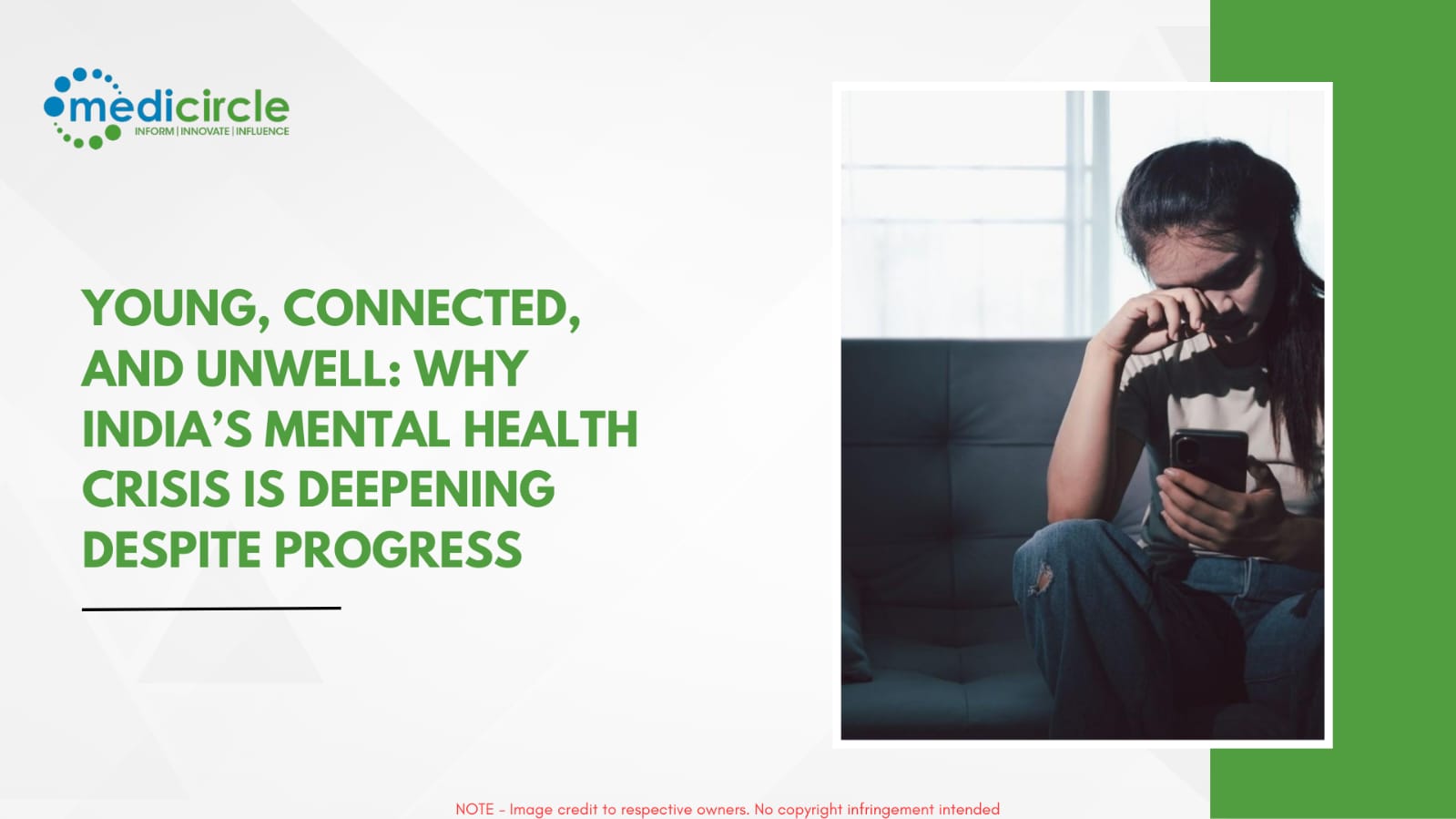
 A society’s future depends on the emotional strength of its youth. When young adults report distress at large scale, the implications extend to productivity, relationships, and long-term public health.




India stands at a defining moment in its public health journey. The country is young, ambitious, digitally connected, and economically evolving at remarkable speed. But beneath this energy lies a troubling reality. Recent findings from the Global Mind Health study by Sapien Labs reveal that Indian young adults are struggling significantly with mental well-being, ranking 60 out of 84 countries in overall Mind Health Quotient scores. Even more striking is the internal contrast: Indians above the age of 55 are performing far better on mental health indicators than those between 18 and 34.
This generational divide forces us to ask a difficult question. Why are the most technologically empowered, socially aware, and globally exposed generation reporting the poorest levels of mental well-being?
The Mind Health Quotient, or MHQ, is a composite measurement designed to assess emotional resilience, cognitive clarity, social functioning, and overall psychological balance. It moves beyond diagnosing mental illness and instead evaluates how well individuals are functioning in everyday life. In this framework, a score around 100 indicates that individuals are coping effectively and managing daily stressors. Indian adults over 55 are close to that mark. In contrast, young Indians average close to 33, a level categorized as distressed or struggling.
The contrast is not minor. It represents a fundamental shift in how different generations experience life. Older Indians, who grew up with limited digital exposure, stronger extended family structures, and slower-paced lifestyles, appear to maintain steadier emotional ground. Younger Indians, raised in the era of smartphones, social media algorithms, economic competition, and urban isolation, are navigating a far more complex psychological landscape.
Globally, this is not an isolated phenomenon. Across nations, the 18–34 age group reports lower mind health scores compared to older adults. However, the pattern is particularly pronounced in economically advanced societies. Paradoxically, countries with higher per capita income and greater access to healthcare services often report poorer mental health outcomes among youth.
This challenges a long-held assumption that prosperity automatically leads to psychological well-being. The findings suggest that wealth, infrastructure, and medical spending do not guarantee emotional resilience.
In India, mental health awareness has improved over the past decade. Conversations around depression, anxiety disorders, stress management, and therapy are more open than ever. Corporate workplaces offer wellness programs. Universities conduct counseling sessions. The stigma surrounding mental illness is slowly eroding. But awareness has not translated into improved outcomes for young adults.
One possible explanation lies in the transformation of family dynamics. Indian society traditionally relied on close-knit family structures for emotional support. Multigenerational living arrangements offered daily interaction, guidance, and shared responsibility. According to associated findings, young adults who report poor family relationships are significantly more likely to fall into distressed categories. Those who feel emotionally close to family members tend to demonstrate stronger mind health scores, regardless of income levels.
Interestingly, in India, closeness to family has a stronger correlation with mental well-being than financial status. This insight carries profound implications for mental health policy. Economic growth alone cannot substitute for meaningful relationships. Emotional connection remains a protective factor against psychological distress.
At the same time, urban migration and career mobility have altered living patterns. Many young Indians move away from home for education or employment. While independence brings opportunity, it can also bring loneliness. The support system that once absorbed life’s pressures may now be physically distant.
Another influential factor is digital exposure. The global average age for receiving a first smartphone is approximately 14. In India, it is slightly later, yet the immersion is intense once it begins. Social media platforms, gaming environments, and constant online engagement shape identity formation during adolescence. While digital tools connect people across continents, they can fragment attention and amplify comparison.
Studies worldwide have linked excessive screen time to sleep disruption, mood fluctuations, attention deficits, and reduced face-to-face interaction. For young adults balancing academic stress, career uncertainty, and evolving relationships, digital overload can intensify vulnerability. The modern brain is navigating a pace of information that previous generations never experienced.
Dietary changes add another layer to the mental health equation. Consumption of ultra-processed food has increased sharply among young Indians. Such diets are associated with inflammation, metabolic imbalance, and emerging research suggests potential links to mood disorders. Nutritional psychiatry is a growing field examining how gut health and mental health interact. While diet alone does not explain declining mind health scores, it contributes to a broader pattern of lifestyle shifts.
The COVID-19 pandemic further disrupted psychological stability. Lockdowns isolated young people during formative years of education and career entry. Many experienced job losses, academic interruptions, and social disconnection. For individuals already reporting lower resilience prior to 2020, the pandemic intensified stress. Recovery has been uneven. While older adults have returned to baseline mind health levels, younger cohorts appear to remain affected.
Globally, the data challenges healthcare systems. Western countries have dramatically increased mental health spending over the past decade. The United States allocates billions annually to mental health research and treatment. The United Kingdom’s National Health Service dedicates substantial funding to psychiatric services. Yet large investments have not yielded proportional improvements in population-level outcomes.
This raises a critical issue: Are we treating symptoms while overlooking root causes?
Traditional mental health models focus on diagnosis and therapy. They address depression, anxiety disorders, bipolar disorder, and other psychiatric conditions through medication and counseling. These interventions are essential and life-saving for many. However, population-wide declines in mind health suggest that broader social and environmental factors may be shaping psychological vulnerability.
Young adults today face constant performance evaluation. Academic competition begins early. Social validation often occurs online through metrics such as likes, followers, and digital visibility. Economic aspirations rise alongside exposure to global lifestyles. The pressure to succeed, coupled with uncertain job markets, creates chronic stress.
Moreover, spiritual and community engagement has shifted. Earlier generations often participated in collective rituals, neighborhood gatherings, and shared traditions that reinforced belonging. While modern India remains culturally rich, urban lifestyles can reduce participation in communal activities. When belonging weakens, emotional resilience may follow.
The generational comparison also highlights perspective. Older Indians have lived through economic liberalization, technological transitions, and social transformation. Many endured scarcity in earlier decades. Their life narratives may include hardship balanced by gratitude for progress. Younger adults, born into relative abundance, measure themselves against global standards. Expectations have grown taller, and disappointment can feel sharper.
This does not imply that older generations were immune to mental distress. Rather, the context of stress has evolved. Modern stressors are less visible but constant. Notifications never stop. News cycles rarely pause. Global crises stream into personal spaces. The nervous system, designed for episodic threats, now responds to continuous stimulation.
India must consider preventive mental health strategies. Counseling services alone cannot address environmental triggers. Policies that encourage work-life balance, promote digital literacy, and strengthen community engagement may play a larger role than previously recognized.
Educational institutions can incorporate emotional regulation training alongside academic curricula. Corporate sectors can create psychologically safe workplaces. Urban planners can design public spaces that encourage interaction rather than isolation. Families can prioritize conversation over screen time.
Healthcare professionals emphasize that mental well-being is multidimensional. It involves emotional awareness, cognitive function, sleep hygiene, physical activity, nutrition, and social connection. When any of these pillars weaken, vulnerability increases.
The findings from Sapien Labs offer a mirror rather than a verdict. They reveal patterns but do not define destiny. India, with its demographic advantage and cultural depth, has the opportunity to shape a new mental health model. Instead of replicating high-cost systems that show limited population improvement, the country can invest in preventive care rooted in community values.
The conversation must expand beyond clinical diagnoses. Mental health awareness campaigns often highlight depression and anxiety, yet mind health encompasses broader functioning. It includes the ability to concentrate, maintain relationships, manage stress, and find meaning. Addressing root causes requires interdisciplinary collaboration between psychologists, sociologists, educators, nutritionists, and policymakers.
Young Indians are not weak. They are navigating an unprecedented era. The digital revolution, economic transition, and global exposure have arrived within a single generation. Adaptation takes time. With targeted intervention and societal reflection, resilience can be strengthened.
India’s older adults demonstrate that stability is possible. Their stronger MHQ scores suggest that protective factors exist within the culture. Rebuilding intergenerational dialogue may bridge emotional gaps. Encouraging family closeness, which data suggests is deeply protective in India, can serve as a foundation.
Mental health research must also expand locally. Indian cultural nuances differ from Western contexts. Urban and rural experiences vary widely. Gender dynamics, educational pressures, and economic disparities influence well-being. A comprehensive national mental health strategy must account for these layers.
The generational divide in mind health is not merely a statistic. It is a signal. A society’s future depends on the emotional strength of its youth. When young adults report distress at large scale, the implications extend to productivity, relationships, and long-term public health.
At Medicircle, we view this moment as an opportunity for thoughtful change. Mental health cannot remain an afterthought in healthcare discussions. It must stand alongside cardiovascular health, diabetes management, and cancer screening as a priority. Preventive mental healthcare, accessible counseling, digital hygiene education, and nutrition awareness should be mainstream conversations.
India’s story has always been one of resilience. The same ingenuity that built technological hubs and global enterprises can be applied to building emotional strength. The data from Sapien Labs does not define failure; it invites reform.
The question is no longer whether young Indians are struggling. The evidence is clear. The real question is how the nation responds. Will we continue to focus primarily on treatment after crisis, or will we invest in environments that prevent decline?
The health of a country is measured in more than economic growth. It is measured in clarity of thought, quality of relationships, and the quiet confidence of its youth. If India chooses to address the deeper drivers of mental well-being including family connection, balanced technology use, meaningful community engagement, and holistic healthcare. It may transform a worrying ranking into a turning point.
The crisis is visible. The solutions require courage. The future of Indian mental health depends on recognizing that prosperity without emotional stability is incomplete. Only when progress includes psychological resilience will the nation truly move forward






.jpeg)








.jpg)
.jpg)
.jpg)
.jpg)
.jpg)
.jpg)


.jpg)
.jpg)
.jpg)